Michael Baugh CDBC CPDT-KSA CSAT
Dog Separation Anxiety is a label we attach to a syndrome of behaviors. Dogs, when left alone, who do one or more of the things listed below are often referred to as “having” separation anxiety.
- Barking
- Whining or crying
- Howling
- Digging at the floor near exits
- Scratching doors and walls
- Chewing around doors and windows
- Losing control of their bladders or bowels
- Panting
- Pacing
Some trainers refer to this as dog isolation distress, as it only occurs when the dog is alone. They reserve the term separation anxiety of dogs who have attachment to one specific person. Nonetheless, Separation Anxiety is widely accepted as referring to dogs who panic when left alone without humans in general. It sticks. So, we’ll go with that term.
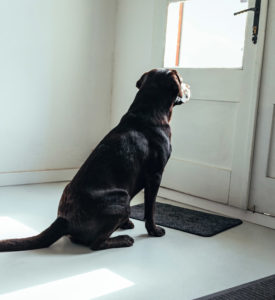 Did I cause my dog’s separation anxiety? Probably not. Let’s go ahead and lift that weight off your shoulders right now. Your dog’s behavior is not your fault. There’s a lot of emerging research about separation anxiety but specific causes still elude us. It’s safe to say that attention, love, allowing them on furniture, or staying home with them for many hours a day are not causes. Lot’s of folks do those things and there’s just no significant correlation to suggest a link to separation anxiety.
How do I know for sure my dog has separation anxiety? Your Certified Separation Anxiety Trainer (CSAT) can do a live video assessment of your dog when they’re alone to help you determine that. You can also set up a live video link yourself without a trainer monitoring. Leave and watch your dog’s behavior on your phone or tablet. Do you see any of the behaviors listed above? Does it look like your dog is panicking? If so, separation anxiety might be the problem.
My dog follows me everywhere. Is that separation anxiety? No. This behavior, whether you find it cute or annoying, shows up in a ton of dogs who have no other indicators for separation anxiety. Interestingly, some dogs with separation anxiety don’t do this at all.
Will my dog grow out of separation anxiety? It’s doubtful. I won’t say that there aren’t some dogs who adapt and appear to resolve their own behavior. There probably are some. However, they would be the exception to the rule. The more common trend is the separation anxiety behaviors solidify and sometimes intensify over time.
Will medication help my dog’s separation anxiety? Only a licensed veterinarian or veterinary behaviorist can prescribe or even consult with you about behavior medication related to separation anxiety. FDA approved medications do exist. Are they right for your dog? I don’t know. We do know that in many cases medication in combination with behavior training can be effective.
 Can separation anxiety be cured? I don’t use that exact word. But, it can certainly be helped. Certified Separation Anxiety Trainers (CSATs) like myself have had excellent results extending the time our clients’ dogs can spend alone quietly and calmly. It’s a fairly straightforward process. However, this does not always mean the process will be easy. A CSAT dog behavior coach can help you navigate the tricky parts and assist you so that your dog’s training will go as smoothly as possible.
How long will it take? Your CSAT dog behavior coach can help you set your dog up to succeed as fast as your dog is able to go. We bring our A-game to the process and we help you and your dog find your A-games as well. We also help you set and track measurable goals. The exact speed of progress is different for each dog. It can also vary (speeding up and slowing down) throughout the course of training. Broadly speaking, we suggest people think in terms of months not weeks.
Can I do separation anxiety training on my own? You can. In fact, in my opinion we CSATs should all be teaching our clients how to work on their own after they’ve worked with us. There are also good online courses for dog separation anxiety (and more in development). We can recommend some of our favorites.
Do separation anxiety trainers come to my home? Usually not. That’s actually good news. It means you can work with the CSAT of your choice no matter where you live in the world. Separation anxiety training is a clear process designed to teach your dog to become more comfortable (calm) staying on their own. Having someone come to your house to teach your dog to be alone doesn’t make much sense once you think about it. Come over. Now leave. Then, of course, there’s be the question of how we monitor your dog when we do leave. Better to have the video link set up from the get-go so we can help monitor and assess your dog’s alone-time behavior no matter where we are.
 Is separation anxiety training expensive? Yes and no. It depends on who you ask. Compared to a 6-week basic obedience class, yes it’s very expensive. Broadly speaking a multi-month course of separation anxiety training with a credentialed trainer is comparable to a multi-week board and train. It’s much better value for money. You are getting months of daily customized one-on-one coaching. CSAT dog behavior coaches are very transparent about pricing. My separation anxiety prices are on my web site.
The first step, though, is free. You can follow this link to set up a free 30-minute separation anxiety call. I’m sure you have questions I didn’t cover here. You can ask those on the call. And, of course, I’ll get to learn more about you and your dog. And yes, it’s really free. You can sign up for your first 4-week training package on that call. But, you don’t have to.
For me this is the big question: Is there hope? Yes! Absolutely, there is hope. Countless dog guardians have walked the path to recovery from separation anxiety ahead of you. And, I’m here to walk it with you – every step of the way – as long as you need me. Seriously, if you have read this far you’ve already taken the first step. Let’s keep going.
Michael Baugh is a Certified Separation Anxiety Trainer based in Texas. He also helps families with dogs who have other behavior issues including aggression.