
Michael Baugh CDBC CPDT-KSA
Phenomenology is one of my favorite geek words. It’s the study of subjective experiences, how another individual perceives the world from his or her point of view. It’s also the philosophical study of other being’s awareness of self. Think about that for a moment, and then let your thoughts wander to your dog. Think just for a moment, but not too long. Pretty soon you’ll circle back and realize all we can really know is our own experience of self and the world around us. I don’t want us to get that far, though.
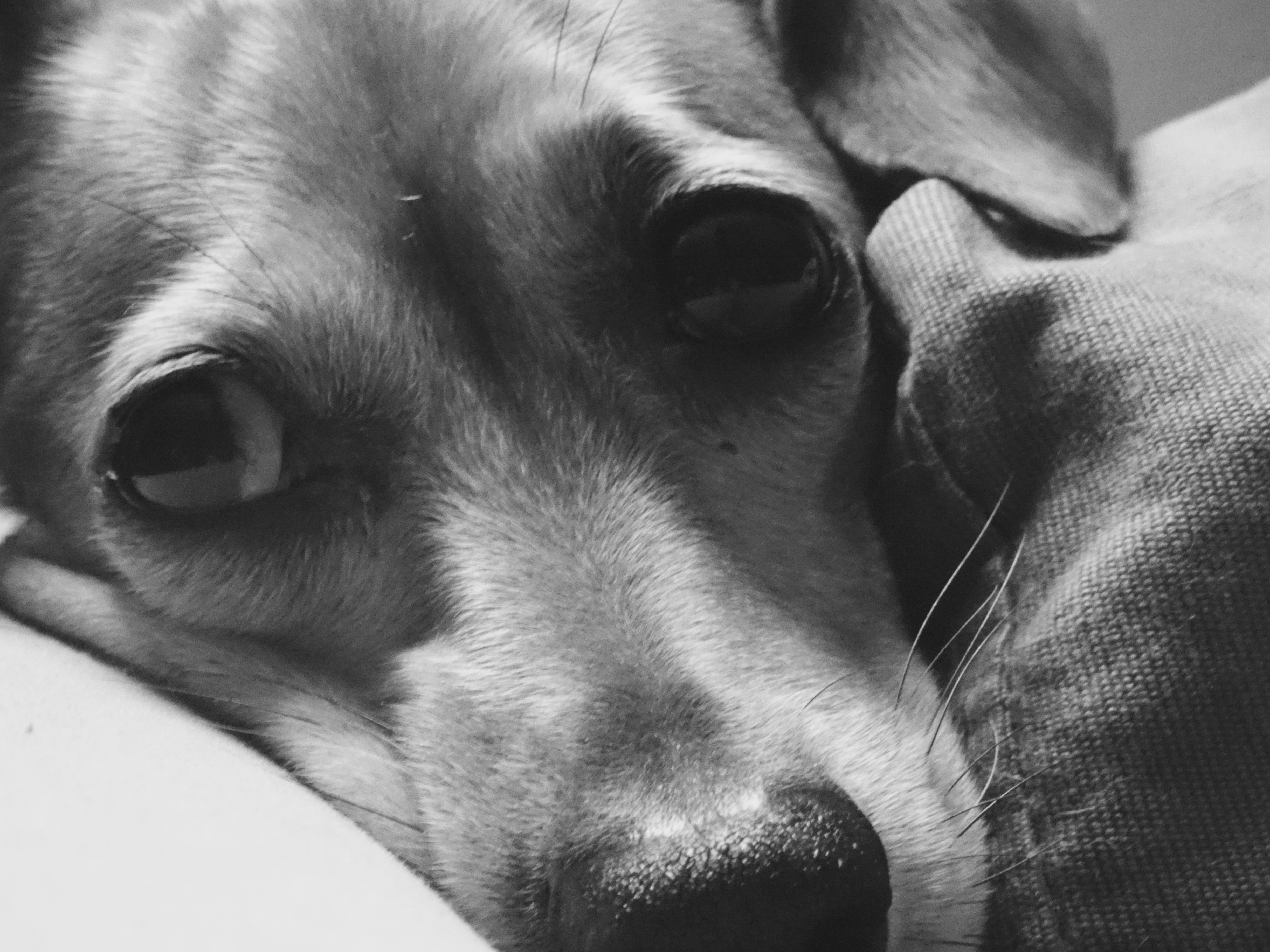 Those of us who love dogs have all contemplated phenomenology. Chances are you’ve looked at your dog and wondered what is he thinking or how does he feel about this or that or does he love (specifically, does he love me)? We humans are natural storytellers from as far back as our cave drawing days. We try to answer those questions about our dogs and sometimes not too well. We think we know what they know or what they feel and we tell it like we see it. Maybe we’re right, but chances are we’re not. That’s the thing about phenomenology. How do we know for sure what what another being’s (our dog’s) private experience is?
Short answer: We can’t. Slightly longer answer: Of course we can try. We should try.
You don’t have to know me very long to know my personal point of view on “training” dogs. Teaching and learning are keys to opening a door between two beings – us and our dog – thinking, feeling, living beings. What better way is there to learn who our dog is than by pushing that door wide open? Let’s be present and aware of what our dog is doing and how he responds to what we do. We know from experience (and the great work of behavior scientists) that dogs learn from the feedback we provide them. And yes, we are learning from the feedback they are providing us (their understanding or misunderstanding of us is evident in their behavior). So, here we are, Dogs and humans in a steady exchange of information – learning the world as the other perceives it. We could call it a phenomenological approach to dog training.
As long as we’re geeking out let’s talk about the philosopher Martin Buber. He brought us the ideal of the I-Thou relationship between two beings. These are genuine connections in which the individuals see or strive to see who the other really is and how the other sees his or her existence. It’s a short hop to phenomenology and what Psychologist Carl Rogers referred to as a phenomenological approach to counseling and teaching (see, I didn’t make it up). At the root of all this, of course, is empathy.
Let’s get back to our dogs. We can start to experience how our dogs feel and think by watching how our they interact with their world. We just need to stop – stop and be with them – stop and notice them quietly. Stop talking for a moment. Set aside all those commands and ideas of what he should or shouldn’t be doing. Just watch. Who is your dog? What is important to him? Given the chance, how does he begin interacting with you? This takes a fair bit of patience sometimes (not always). It also requires that we dig a bit into our own empathy reserves. Can you imagine? Can you relate? Give phenomenology a test drive – see the world as your dog might – imagine yourself as your dog imagines himself (whoa).
I forgot to mention something else about Martin Buber and the whole I-Thou thing. We go into this process humbly. Neither being is above the other. That was a big deal for Dr. Rogers in counseling and teaching, too. We meet our dog on equal ground – just two living, thinking animals in a common space and time. Cesar Milan and the other “show ’em who’s boss” trainers are spinning at the thought of this. But, give it a go. It might do you and your dog both some good. What’s it like being you? What must it be like for your dog to be him? Open mind. Open heart. I-Thou.
How different is it now to think about training? Could we take a phenomenological approach – we and our dogs meeting on a level playing field – learning together – from each other – interested in each other – equally? As equals. Heresy? Nonsense. It’s thrilling. Fun even.
Hello dog, I’m bipedal and take great pleasure from things I see and here. Dog: quadruped – enjoys smells that to him are like symphonies and Cezanne’s.
Human: speaks but also has facial expressions and other non-verbal communication.
Dog: communicates nonverbally but also vocalizes.
Predator: Dog – check. Human – check.
Emotions, including joy, fear, anger, sadness, and excitement: Human – check. Dog – check.
Wanting and seeking good things / pleasure: Humans and dogs – check and check.
Avoiding pain and other crummy stuff: Yup. Both of us.
It’s a bit ironic that the dog trainer’s hero, Dr. Burrhus Frederick Skinner, frequently disagreed with and publicly debated Carl Rogers. Skinner is the one who showed us how to influence another being’s behavior by providing or withholding reinforcement. Folks back in the day (most especially Rogers) thought the approach was sterile and non-feeling. The irony here is that it’s exactly this approach that fuels communication with our dogs in the real world. It takes little more than a few minutes to realize that what we call training sessions are actually conversations. We are showing our dogs how we’d like to live with them, reinforcing their behavior. But aren’t they too showing us what they want and need? Don’t they reinforce our behavior? Let’s meet, dog and human, and work this out. I-Thou, indeed.
And what about that question of love I so deftly left behind? Phenomenology. Seeing the world as you see it. Understanding the idea of another being’s self as you understand yourself. Does my dog love (specifically me)? Can we know for sure? I’ll save us both the disappointment of the short answer. My hope is that the longer answer, the real answer, lays out on that level playing field, the place where we teach and learn with our dogs, equally engaged and connected if only in the moment. Love and hope, they are so closely related. Maybe it’s best if we keep both always at hand, inextricably bound to our own sense of self, and our own perception of the world. Let those help us tell the story of our dog, and the love and hope we trust he must also feel.