The Gift of a “Perfect” Dog


Michael Baugh CDBC CPDT-KSA

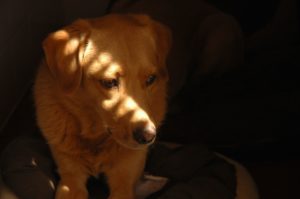
I sit on the floor because I’m having a moment. Okay, here’s the truth. When I say I’m having a moment I mean I’m having a cry. Stella, my old retriever mix, gets up slowly and walks over to me. I don’t know why I’m crying. Maybe it was a sad story on the radio or an email about a client’s dog. Maybe neither of us knows why I’m crying but here she is, leaning in, sniffing my face, the tears. And, maybe neither of us knows why she walked over to me, why she is so gentle, why she seems to care. It’s just her way. And, here’s the other truth. It’s why I’m sitting on the floor. This is her gift and she offers it just the same every time and I know that.

This will be the summer that Stella turns 13. She was 5-months when I pointed to her cage at the Houston SPCA and said “That one. I want her.” We didn’t know she was sick at first , distemper, respiratory then neurological, usually fatal. But, I knew what we were up against when we finally got the diagnosis. The week after we adopted Stella distemper swept through the SPCA and killed half the dogs there. The first time I sat on the floor and cried with Stella was a couple weeks after we brought her home. I was holding her. She was all legs even then, twitching uncontrollably, crying because she was so uncomfortable, crying because she didn’t know why. I was crying because I did.
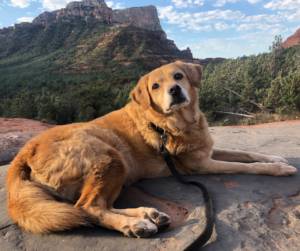
That was the worst night. The ones after were better. Stella did what we all hoped for but didn’t dare say aloud. She lived. She lived for months and then years and then a decade and more. She learned to swim and to dive and to climb steep paths to the top of red rocks. Stella grew to be strong and clever and awkward and weird. She is long-legged and small-headed and remarkably beautiful but only at just the right angle. And even now I sometimes look at her and think, that one. .

We brought Stewie home when Stella was barely 18-months. He was small and scrappy, fresh from a run through a tropical storm and a close call with a speeding car. The vet said he was 2 or 3. He had a collar but no tags. Testicles but no microchip. I put up signs and called the shelters but no one claimed him. And, here’s the truth. I could understand why. He was a hot mess, shitting and pissing indiscriminately, claws like an iguana and a piercing scream at the sight of nail clippers. He wasn’t crate trained or leash trained or anything trained. No wonder no one claimed him except us. My partner, Tim, was at the sink when he rather stoically pointed to Stewie and said (as if issuing an edict) “We can keep him.”
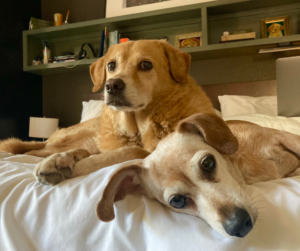
Stewie learned potty training and pedicures, but also paths to the top of red rocks. That brush with a fast-moving car faded with quickly passing years (though, he’s still afraid of storms). Stewie is about 14 or 15 now, the last 12 with us. It’s been 12 years of Stella and Stewie, of I want her and we can keep him. It’s been hard for a long time to imagine one without the other, each of them so a part of the other, so a part of us. They were each a gift, dubious and imperfect. Now they are treasured gifts, imperfect still, but perfectly fitted to our lives and to our hearts.

We all want the perfect dog. But, here’s the truth. Perfect isn’t packaged up for us to get. It’s not the right breed, or the right breeder, or the right boot camp we send our dog away to. Perfect is years of giving. Perfect is vet visits and cleaning up messes and nail trims. Perfect is swims and leash walks and hikes up steep red-rock paths. Perfect is awkward and scrappy, her and him, month after month, year after year. Perfect isn’t something you buy. Perfect is something you create, the giving and the receiving, the forging of a friendship (maybe a best friendship), with a being who will never speak a word but communicates so beautifully nonetheless. Perfect is earned. Perfect is dried tears at the end of the day, near the end of a life well lived, with a good girl and a good boy, on the floor.

Stella walks up stiff-legged, her face next to mine, and I lean into the thick fur around her neck that doesn’t quite match the rest of her body. Such an odd-looking dog. Awkward. Perfect.


Michael Baugh specializes in aggressive dog training in Houston, TX
Five Things to Know about Dog Resource Guarding


Michael Baugh CDBC CPDT-KSA

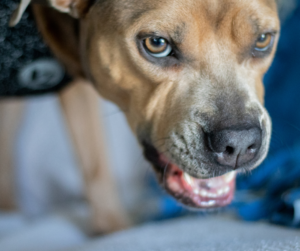
Many dogs hide, cower, freeze, stare, snarl, growl, snap or bite when they are guarding something. For the purposes of this blog post we will call that resource guarding, dogs who claim possession and guard a prized object, place, food related item, or food itself.

Resource guarding is normal dog behaviorThis fact surprises a lot of people. We have a romanticized view of dogs including the idea that some are good and some are evil. Ascribing this kind of moral code is a disservice to them and to ourselves. They are animals, as are we. Animals protect valuable resources, as do we. Wanting to keep our stuff is hardwired into us. Yes, we can share. But, you might also have a few things to say to a random dude at a restaurant who pops one of your french fries in his mouth and walks off.

Normal does not mean acceptable. Some dogs do take it too far. I agree. Who among us really wants our dog’s scrap of stinky frayed fabric that used to be a stuffed toy? It doesn’t make sense that he bit Aunt Sally when she reached to pet him while he rested his head on that disgusting thing. Some dogs (and humans) can get weird about their prized places and things. It seems a bit out-of-context, a bit too much.

It can be dangerous. Dogs who guard a lot of things, including random stuff they find, can be hard to predict. Is he guarding that leaf, that remote control, his poop? It can get especially dangerous if the dog bites to protect his vast and changing collection of valued things. One mistake can turn bloody.

Dominance and conflict-based training can make it worse. From the dog’s point of view resource guarding is about a perceived conflict. He’s already gearing up for a fight. Training methods focused on dominance are conflict-based. This outdated training approach frames every interaction with our dog as a competition with a winner and a loser. We end up proving to our dog that his already-inflated sense of danger is in fact justified. That sock is very valuable. This is a challenge. Violence is possible if not inevitable. Every time we approach resource guarding from this skewed  perspective we risk the dog escalating his response. We actually make the resource guarding and the intensity of our dog’s behavior worse.

There is hope. We humans have already won the evolutionary race. We have nothing to prove to our dogs other than this: I can help you. This is good news for dogs and for humans. We now have smart, simple, and effective aggressive dog training techniques for quelling resource guarding in dogs. These reinforcement-based methods work and (I promise) do not jeopardize our position as the dominant species on the planet. You can reach out to me or a similarly credentialed dog behavior consultant for help. Or, contact a veterinary behaviorist.

Bottom line: Resource guarding is normal but it is not okay. There is hope.  You can have a long and enjoyable relationship with your dog.

Michael Baugh specializes in aggressive dog training in Houston TX.

Can You Teach a Dog to be Afraid?


Michael Baugh CDBC CPDT-KSA 

It turns out people rarely ask. Instead, they just assume that if we comfort a fearful dog that we must be reinforcing fear. They grow even more concerned if we use food. The answer to the unasked question is layered and a bit technical. I usually don’t go into detail. I just reassure my fearful client that we are not, in fact, reinforcing or rewarding their dog’s fear.

The truth is we can teach fear, but not in the way most people are worried about. The process is called associative learning, sometimes called classical conditioning or (more commonly) Pavlovian conditioning. Don’t go to sleep. It’s pretty interesting stuff. When I was much younger I taught my dog to stay out of the basement. When she was a puppy, the first time she peered down the basement steps I dropped a book and it made a loud bang on the hardwood floor. She startled and ran away from the door, never to return again. Ever. Seriously, she never went into the basement. I associated the open basement door with a loud and startling noise. The open door was forever frightening enough that she never approached it again. I taught her to be afraid of it.

Some trainers teach dogs to fear the beep on a shock collar. The dog only has to get shocked once after the beep for it to work. It’s a learned fear. Even a minor car crash can teach dogs to be afraid of the car forever. Car sickness can do that too. I once worked with a dog who was terrified of the garbage truck. At first she learned to fear the sound of the truck in the distance. Before too long she had learned to fear Wednesday mornings (garbage day). Benign things, a beep, a car ride, or a day of the week, become frightening because of the terror they once predicted predict.

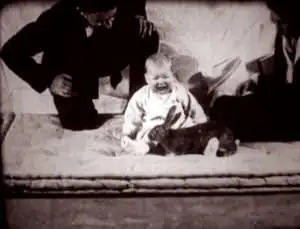
John Watson became both renown and notorious when, building on Pavlov’s findings, he conducted the infamous Little Albert experiment. He taught a 9-month old baby to fear soft furry animals by associating them with a loud startling noise. The child ended up having a phobia of rats, bunnies, even dogs. Ethical restrictions would prohibit this type of research today. Still, governments used this part of behavior science to elicit extreme fear responses associated with otherwise unremarkable words, gestures, or environmental triggers. They did this by associating those things with torture including beatings, shock, sleep deprivation, drugs, and hypnosis.  It’s a dark and not-so-distant part of our history and an interesting revelation of how emotions work.

Yes, fear can be learned. Lot’s of dogs have learned to be afraid of people, places, and situations. But, using food never taught a dog to be afraid. The function of fearful behavior is to escape something scary. It’s not to earn a bit of cheese. Maybe this example will help.

What if I gave my dog some cheese for looking at a man she was afraid of. This guy is cool; he’s just sitting there. But, what if my hypothetical dog has had a hard time with men in the past? What if now they are all pretty much suspect? So, she looks at this guy with her ears back and tail tucked (obviously afraid). Is offering the cheese going to make her more fearful of men in the future (because that is the definition of reinforcement). The short answer is no. Let’s break this down.

  • My dog refuses the food. This is a typical behavior when dogs are very afraid of something. The food does not register. In this case the food has no impact on future behavior or emotions. My dog remains roughly as afraid of the man as she was before.
  • My dog doesn’t get a chance to take food because the man gets up, talks to her, and reaches to pet her. In this case, her possible curiosity is met with the exact thing she feared the most. Her fear would be maintained or made worse.
  • My dog takes the food. Better yet, I present a conditioned marker (like a click or the word “yes”) when she looks. She then looks back at me and takes the food. I’ve just reinforced looking at the man and then looking away. I’ve also associated the sight of a man with food (not a startling or painful outcome). I now have the beginning of a new behavior pattern: See man; Look at him; Then look to me. I also have the beginning of some new associative learning (Seeing a man predicts food from me). In this case fear is actually reduced.

Plot twist. We need to get the order of events correct. If we present the food first and bribe the dog to approach the man, the dog may play along. She may even take the food. But if she gets too close and the man scares her our whole plan falls apart. Food + man + startle = Fear. Before long our dog will grow suspect of the food itself, and rightly so. Food in that context will elicit a fear response (likely retreat and avoidance). Dog guardians often mistake this as the dog not being interested in food or simply being stubborn. Not so. We accidentally taught her that food in this case is not a predictor of good things to come. It’s a trick.

Bottom line: Fear can be learned. In fact we remember fearful events for a very long time. Seemingly harmless triggers can get hooked into fear. Only unpleasant outcomes (think scary or painful) reinforce fear. Food can become one of those harmless triggers that get hooked into fear if we use it incorrectly (as a bribe or a lure). Food, though does not reinforce fear. It reinforces behavior. When used well food can help quell fear. So too can a kind voice, a gentle touch, a little space, and some time.

Michael Baugh is a dog behavior expert in Houston, TX. He specializes in fearful and aggressive dog training.