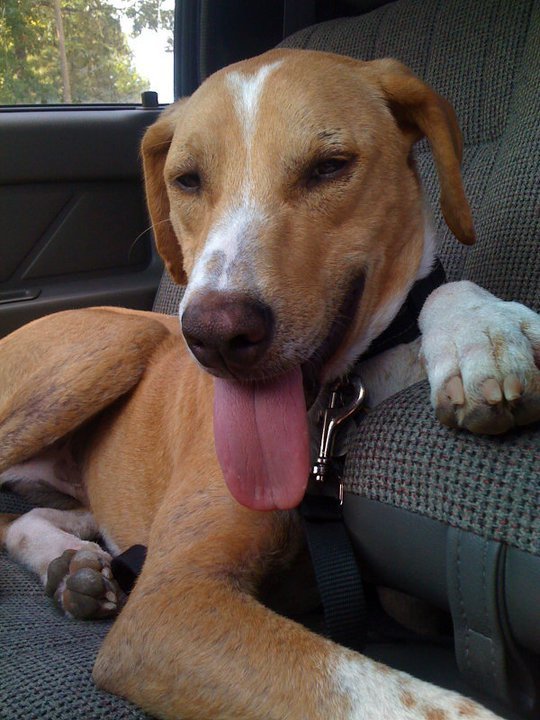
If you spend any time on Facebook you’re going to see the pictures – people hugging their dogs, kissing their dogs, lounging on their dogs, even kids riding dogs. The human faces are all aglow with rapturous bliss. More often than not, however, the dog looks like he just wants to get the heck out of there. Of course, most of us are oblivious. Let’s not forget that ignorance is part of what makes the bliss so wonderful. I mean that in the nice way. We love our dogs. We just don’t seem to know what they like and don’t like.
 I’ve been guilty myself. That picture of me and Stella is the most glaring evidence. I’m all this is great. She’s all please just let this be over soon. Look at her face, the eyes, the way she’s actually leaning away from me. Her ears are pulled back, too. That’s another sign. You don’t have to believe the picture, though. Right after that shot was taken Stella started to wiggle her way free of my loving arms.
Nobody wants to be a party pooper, but here’s the bottom line. Dogs and humans don’t exactly show affection the same way. We drape our arms around the shoulders of people we like. To a primate (including human primates) nothing says you’re special like a hug. To a dog, it can feel like a threat. Watch what happens when a dog drapes his head over the shoulders of another dog. Trouble. That’s not to say dogs don’t learn to tolerate our hugs; they do. But it doesn’t come naturally to them.
Author Patricia McConnell (The Other End of the Leash) was one of the first to point out this kind of miscommunication between people and dogs. Humans are all about reaching with arms and touching with hands. Dogs have neither. They greet with noses, mouths, tongues and teeth. It’s an odd pairing, no doubt.
Still, all is not lost. There’s lots of evidence to suggest that dogs love to be touched. In fact, the sense of touch is among the very first senses to develop in newborn puppies. They root to nurse. Feeling is essential to surviving. That lives on in their relationships with us, and many dogs are quite cuddly and enjoy a good evening on the sofa with their favorite person.
Like people, though, dogs are individuals. Some have sensitivities to being reached for or touched, much less hugged. Many dogs have little or no experience with the way we humans show affection. Our ways may be scary to them even if our hearts are in the right place. A child lounging with his head on a dog’s chest may look postcard cute. But for the dog it might be more than a little freaky. That, along with hugs, can get a child bitten. I know. I’m the guy people call when their dog bites their child.
So what are we to do? We have so much love to give and so do our dogs. Here are some tips for a good, affectionate relationship with your dog.
Listen to your dog by watching your dog. Your dog’s language isn’t verbal; it’s visual. When you initiate some sort of physical interaction with your dog, watch to see how he responds. Does he snuggle closer, or does he walk away? If he does the latter, that means he’s not comfortable. Wide-open frightened eyes, ducking head, ears pulled back flat are all signs too. Some dogs also wrinkle their foreheads when they are worried. Notice those things and then give your dog a break. He’s communicating with you. You’re his friend so respond by giving him a little space.
Let your dog make choices. If your dog doesn’t want to snuggle and chooses to walk away – let him. It’s not personal. Try this. Begin some sort of physical contact, like petting your dog’s face, and then stop. What does your dog do next? Does he nudge your hand for more petting? That’s a choice that says more please. Let your dog make choices and respect those, especially if his choice is to disengage for a while. Never force physical contact. He’ll come around.
Be your dog’s advocate. Not every dog will want to interact with every person. This is especially true when it comes to children. If you notice your dog trying to communicate that he doesn’t want to be touched or approached, speak up on his behalf. It’s okay to ask a person to stop petting your dog, or even to step away from your dog. It’s is essential that you interrupt a child who is making your dog uncomfortable. That’s a safety issue.
If a dog is really uncomfortable, he will let us know in all the quiet ways we see in those facebook pictures – wide eyes, clenched jaw, tense or leaning away. If we ignore those, a growl or warning snap may follow. And yes, people do get bitten by their own dogs. It’s children mostly, hugging, kissing or riding the family dog.
We teach our dogs how to deal with our quirky human ways. We have to really. While hugging and having their head patted may not come naturally to most dogs, many still learn to tolerate it – even like it. If we’re lucky we learn each other’s limits and work it out. If we’re very lucky we get some of those amazing moments that only dog lovers understand, magical instances where we really connect with our dogs. Sometimes it’s just a look. We’re not even touching at all. If only someone had a camera. We’d show the world.