Dog Behavior and My Fear of the Dentist


Michael Baugh CDBC CPDT-KSA CSAT

One-twenty over seventy-four. I’m lying back in the dentist’s chair with the wrist monitor to my chest when the beep sounds. Honestly, I am a bit surprised when I read the display: 120 / 74. That’s a fairly respectable blood pressure for me on any given day. On dental exam day, it’s an exceptional blood pressure.  A few years ago it would have been unimaginable. I broke into sweats during cleanings and exams. My whole body tensed at the sound of a drill. I fainted once while getting a lidocaine injection. Not today, not with 120 / 74. I smile, slip off the monitor and put on the protective glasses. How did I get from terror to today? And, you might be wondering, what the hell does this have to do with dog training?

Everything.

I’ve helped a lot of people who have dogs who are afraid, afraid of the vet, but also afraid of people in general, afraid of other dogs, of garbage trucks, even dogs who are afraid of leaves in the wind (seriously). My own dog, Stewie, used to be terrified of vet visits, the needle parts especially. Helping dogs work through fear is a process. Notice I didn’t say teaching dogs to … or training dogs not to….  We are helping dogs. And, there are some consistent elements in the process.

  • Set your dog up to succeed. This means creating an environment in which your dog can at least experiment with relaxing. Create a space where safety is possible.
  • Teach a routine. This is optional in many cases. But, I’ve found it’s smart to give the dog a few tasks he can reliably perform for reinforcement. Dogs are great at learning patterns. (This is why I often teach a relaxed down or the look-at-that game).
  • Pay attention to what your dog is telling you about his feelings. If the scene is getting too stressful for him, give him an out. Take a break. Let him catch is breath and settle himself again. When meeting a frightened dog I’ll often ask the human to put the dog in a quiet room away from me several times throughout the visit. He may get as many as a half dozen repetitions of coming out to see me. Each time it gets easier. Taking breaks works.
  • Similarly, let your dog make some reasonable choices. He can tell you when he’s ready to try a more challenging experience. I’m always so pleased when a dog comes out on try number 5 or 6 and casually walks up to me. That was his choice. Part of the routine I taught Stewie for vet visits was resting his head in the palm of my hand (Yes, it is adorable). That tells me he’s ready for his jugular blood draw (no chin rest – no blood draw – not until he’s ready). Letting you dog make some of these simple choices on his own really does speed up your progress.
  • Don’t let anyone shame you. Ignore well-meaning friends who tell you your dog  needs more exposure or that you need to force a situation so he just gets over the fear. Rebuke the myth that giving your dog comfort somehow reinforces fear. This is bunk. And if an animal professional tells you any of this nonsense, gently call them out. At best they are giving you misinformation. At worst, it’s malpractice.

Six years ago I switched dentists. I set myself up to succeed and found a dental practice that truly understood fearful patients like me. (Healthy Smiles Family Dentistry in Houston). Together we established a routine. At this practice, when you arrive on time you are invited back to the exam area on time. There’s no sitting and stewing over what’s about to happen. I set down my phone and glasses. The hygienists and I chat. She never leaves the room (no more waiting alone at all). Then Dr. Vlachakis (Dr. V) and I chat. From the beginning the staff and Dr. V paid attention to what I was saying and feeling. It turns out they consider their patients’ physical and emotional comfort part of their job (Well, that’s refreshing). I remember my first visit when I tried to calmly let them know how scared I was. Meanwhile I was already sweating and my eyes were darting around the room like a scared dog. And, I hadn’t even sat down in the chair yet. “You’ll be okay.” They told me. “Have a seat whenever you’re ready.” I got to make my own reasonable choices. Sit down in the chair when you are ready. It’s a small thing, but a very big deal. They offered me nitrous oxide. I accepted (The truth is we needed to bring my blood pressure down). All I was having done was a cleaning, but I took the laughing gas. And, there was no shame from anyone.

It’s been like this from the first visit, and consistently every visit thereafter. I come in. We go back on time. I’m never alone. I set my phone and glasses down. I sit in the chair and strap on the blood pressure monitor, slip on the protective glasses. The hygienist and I chat. Dr. V and I chat. (She comes in even before the cleanings). And then she asks me, “are you ready.” I usually take a deep breath, even now. “Sure, ready.” Ready for cleanings. Ready for the occasional filling. Ready for an implant. Ready for veneers (Yup, I opted in for cosmetic dentistry). Ready with nitrous oxide for the early visits but rarely anymore. Ready for the chats and always for the kindness, and the sunny view from the chair, and the time to relax. Yes, relax (most of the time).

The blood pressure cuff is on the counter. The hygienist must have forgotten to put in in the drawer. 120 / 74. Wow. We are half way through the cleaning. She pauses to let the suction thing in my mouth do its thing. “You okay?” She asks. “Need a break?”

“Thank you,” I answer. “I’m good.” I take a breath. I’m good.

Michael Baugh teaches dog behavior in Houston Tx. He specializes in fearful and aggressive dog training. Michael also has no cavities as of his most recent visit to the dentist.

Dog Training: One Change Can Change Everything

Michael Baugh CDBC CPDT-KSA CSAT

I’ll cut right to it. If you make one small change to your dog’s environment it can dramatically change your dog’s behavior. Keep in mind, though, a lot of things make up your dog’s environment. It includes you (you’re an important player) and your behavior. It also includes where your dog is, the time of day, other animals present, sights, sounds, and smells. And, let’s not forget the internal environment. We aren’t talking about your dogs thoughts – we don’t get to know what those are. But we can consider his health, if he’s hungry or not, if he’s in pain, and even the effects of medications. So, let’s get back to the point. If we change just one or two things in our dog’s environment we can greatly affect his behavior. I fact, that’s exactly how training works.

Of course, it cuts both ways. A change in environment can cause unwanted behavior, too. That happens all the time. It often takes just a little bit of detective work for us to answer the question: why is my dog behaving this way? A new person in the home or a home in a new city can lead to some fearful or aggressive dog behavior. A sudden change on a walk can be startling and lead to a dog being anxious near certain houses. Your dog with a stomach aches behaves differently than your dog who is well. Otherwise jolly dogs can be grumpy if their hips hurt. Your puppy might be much more unruly at night than in the morning (some clients call this the witching hour). What if it’s raining? What if there is thunder? The variables are endless and they all matter.

This is why I frequently tell clients that their dog’s behavior is a conversation with the environment. In other words, fear or aggression or unruliness or even goodness aren’t personality traits that live inside the animal. We are used to talking about behavior that way, as if it’s part of who our dog is. The truth, though, is that our dogs are never one thing or the other all the time. They aren’t always terrible. They aren’t always fantastic. They are, however, always engaging with their world – every waking hour. That engagement, how they act, is what we call behavior.

So here’s the deal. Change your dog’s environment (even a little) and you can affect a change in his behavior (sometimes by a lot). But, what do we change and when? It depends. And, depending on how serious the unwanted behavior is, you might want to call in a dog behavior consultant like me to help.

I like to start simple. If your dog is doing something you don’t like, block his access to do it again. Just make a change or two to his environment so that he simply can’t or won’t think to do that unwanted thing anymore (whatever the thing is). In other words, set your dog up to succeed. We get this backwards too often, especially on dog training TV shows. We set the dog up to do the wrong thing so we can “correct” him. Think about that. It’s absurd. Let’s set the dog up to avoid the mistake in the first place, so we can more easily show him what we want him to do instead. There are lots of examples ranging from very mild to very serious. Here are just a few.

  • Prevent jumping on guests by having the dog behind a baby gate until he calms down.
  • Prevent fights over food between dogs by feeding them separately.
  • Prevent repeated episodes of separation anxiety by making sure there’s someone to watch your dog when you’re gone.
  • Prevent fence fighting with neighbor dogs by taking the dog out back on leash.
  • Prevent bolting out the door by blocking the dog’s access to the door with additional barriers.
  • Dog bites when picked up? Temporarily stop picking him up.
  • Dog is scared and hyper vigilant on walks? Let’s take a break from walks for a while.
  • Dog attacks workmen? Better put the dog in a back room when the plumber comes.

These are just a few examples of how we can manage our dog’s environment and effectively change his behavior as a result. Some trainers mistakenly refer to this as “just management.” I balk at that. Let’s not downplay how important this is. Setting your dog up to be the best version of himself is foundational training. Moreover, it’s a gift – to him, to yourself, and to your family.

We can take this idea further, of course. There are tons of other ways we can creatively change our dog’s environment to influence behavior change. That’s the stuff of training. Right? You are perhaps the most important part of your dog’s world. You’re a very salient part of his environment every day. What if you made just one change in your behavior? How much of a cascading effect would that have? Let’s say you gave your dog a treat (a small pea-sized piece of cooked chicken) every time he came to you. We will assume he likes cooked chicken. Even if you didn’t call him over, every time he shows up you remember and magically a piece of chicken appears. Can you imagine how much attention he’d pay to you? How near to you would he stay? How much would he keep his eyes on you and follow you and walk beside you and come when you do decide to call him?

That’s an exaggerated example of course. But even using food in training sometimes has a huge effect. So does yelling less and setting aside painful trining tools. Something simple like giving your dog more time to rest and more opportunities to sniff can do more for his behavior than you might expect. Learn how to play with your dog – see what happens. Invite him to follow you rather than picking him up. Move a bit more slowly with vet exams and take breaks. Teach him to ask you to be petted – it’s a fun trick. And, sometimes just keep your hands to yourself. Spend a quiet moment with him and be still. Let him lie near you. Watch him breathing. Smile as his eyes grow heavy. Get comfortable. Share the space.

There’s so much doing – for your dog – to your dog – with your dog. I sometimes think there’s just not enough being. Be quiet. Be still. Be here. With him. Right now. That would be a change. Wouldn’t it? I wonder what we’d discover. How good would that be for both of us?

Michael Baugh teaches dog training in Houston TX and helps clients around the world who have aggressive and fearful dogs.

Online Dog Training – Your First and Best Choice

Michael Baugh CDBC CPDT-KSA CSAT

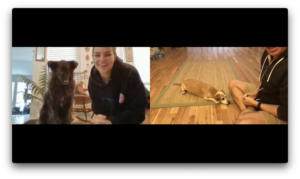
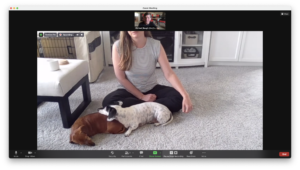
It wasn’t that long ago that folks thought of online dog training (live video coaching) as a second choice. We considered it a good-enough option when in-person training wasn’t available. There are some reasons for that. Dog trainers weren’t as good at remote training as we are today. Fair enough. The other reason, though, is that we just didn’t know what we didn’t know. The pandemic, quite frankly, forced us to immerse ourselves in online learning experiences. Little-by-little it became a welcome part of our comfort zones. We got good at it and we learned how good it could be for us.

Dog training and behavior coaching has some key elements in every case:

  • Setting goals
  • Charting a training plan
  • The trainer modeling specific skills and exercises
  • The client practicing those skills hands-on and getting feedback
  • Review and Follow up

The truth is, not only are all of those things able to be accomplished live on a video connection, some of them are actually better accomplished that way. I take notes for my clients and can often send clients a written training plan the very same day if we are working online. I also record demonstrations and practice sessions and can send a link for those to the client within minutes after our consultation.

And, believe it or not, there are real disadvantages to seeing a client and their dog in-person. For dogs with aggression issues, having a stranger in the home can be very stressful. Half of a training session or more can be wasted just getting the dog to calm down. We don’t have that problem with live video coaching. The client can work with their dog in a calm stress-free environment, skill-building and preparing the dog for real-life encounters later in the process. Dog separation anxiety training is done entirely online. The idea is to help the dog learn how to be calm when left alone. You don’t invite someone over and then leave the dog alone, right? It’s essential that the trainer not be there so that he can monitor your dog’s behavior when left on his own.

It’s normal to have some hesitation around online training. I get it. Many of our clients did at first too. Then the reviews started coming in:

Michael is Very professional and helpful. We were worried about the training being performed virtually at first but found that the training was just as helpful as in person training if not better. – Mary C

I was worried how training might translate over Zoom since we began at the height of COVID, but everything went so smoothly and I think the distance helped Finn to be a bit more natural at home during training sessions. – Corrine B

Even through remote training due to covid, Michael’s professional assessment and training skills shone through and worked wonders. He gave us a customized plan to help her build trust and positive engagement with my husband. – Mabry Family

We met with Michael through Zoom meetings and he helped us immensely with positive training techniques that helped our pup become a loving part of our family. – Pat V

We’ve learned there are other real advantages to live video dog training sessions online, as well.

  • Expert help when you need it. There are still too few dog behaviorists and dog behavior consultants who handle difficult behavior cases. With online coaching you can access experts more easily with less wait time for an appointment.
  • Convenience of scheduling. With no worries about service area or travel time, we can make more evening and weekend time slots available.
  • Expert care and instruction no matter where you are. Online dog behavior coaching is not bound by geography or service area boundaries.
  • Safety. Online coaching is stress-free for dogs with aggression issues.
  • Less stressful for the humans, too. There’s no fuss or worry about having a stranger in your home.
  • Online training costs less.

I’m a watcher of trends. It’s one of my passions. One of the things we are noticing from the pandemic is that we will probably continue to do more work with each other remotely from our own homes. Certainly we crave social interaction in-person. At the same time we are realizing we don’t need that (or want it) for all interactions. If we can get expert help that’s better, quicker, and less expensive, that really should be our first option. Experience has shown me so far it’s likely to be our best option, too.

Michael Baugh teaches dog training in Houston, TX. He’s also able to help people around the world with live video coaching online.