First…
Take a moment to be amazed. We live with dogs, very well most of the time. People don’t cuddle and watch a movie with their squirrel. Folks don’t go on walks or hikes with their beloved javelina. Dogs fill those roles and so many more in our lives.
A 2024 study by Arizona State University researchers, based on surveys conducted in 2021, indicated that two-thirds of dog guardians don’t do any formal training with their dogs at all. That’s amazing too. Our relationship with dogs seems to come naturally. We evolved side by side for over 15,000 years. I cite that fact a lot in my writing because it is so important to remember.
Nature adapted dogs and humans to live together. Amazing? Yes. But nature, it seems, offers us even more for a life with dogs. Something that can look and feel magical.
Don’t miss out.
Positive reinforcement learning is how we communicate with our dogs. Think about it. We can have a conversation with another species who will never speak a word. Learning is our common language. I suspect our ancestors trained with their dogs more than we do. There were hunts to go on, flocks to guard and herd. We should train too. Walks. Coming when called. Cued relaxation. Tricks. Deepen the bond with our dogs that nature handed us.
Understand how important it is.
Learning is essential for mental and emotional health. We need it. Our dogs need it. Yes, dogs and humans have grown up alongside each other. But our shared world is changing so fast, more so in the last 100 years than in the thousands of years prior. Our dogs need us for guidance and support. And we need to keep learning about our dogs so that we can have better lives together with them.
Training isn’t a luxury; it’s essential.
Teach for real life.
Training your dog to jump through a hoop is only fun if you show off the trick. Learning with your dog, really working out a new skill together, is not a solely private act. Bring it into your everyday life. Let us see what you and your dog have accomplished.
Many of my clients’ dogs are nervous or reactive. They spend weeks teaching their dogs to relax on cue, lying on a mat and settling in. Good trainers teach this skill in a low-distraction setting. Excellent ones can apply it in the presence of family and friends and even visitors.
Find your balance. Don’t push your dog’s training too far, too fast. But don’t grow stagnant either.
Learning is functional. Hunt. Herd. Handle the plumber coming over without freaking out.
Live well together.
Your dog is not a list of problems to be solved. Our lives together are too short. Focus, instead, on who your dog can be — who you can be together.
Your training might be about helping your dog handle stressors better. That can look like stopping him from barking; controlling his lunging and snapping. I understand. Of course, we want those things to stop. Now, what do we want our dog to do instead? How can we make that easier for him, and how can we ease his mind in the process? Those questions are the beginning of a strong partnership with our dog. Love for our dog. A life well lived.
… all the way to the end.
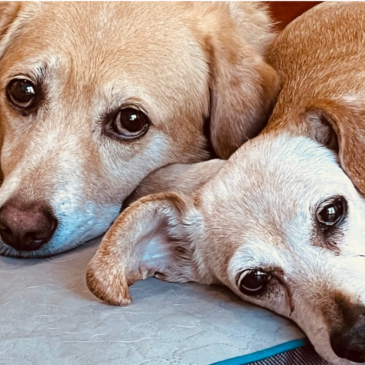
My late dogs Stella and Stewie lived well into their teens. We trained a lot together. They each learned a long list of tasks, including some tasks aimed at reducing unwanted behavior. Yes, there was a list of problems. I admit it.
As they aged, though, the list faded. Even the forward-thinking reasons for training I’ve written here became distant echoes of something much greater. They learned to learn, to adapt, and to trust us more with each passing year. They certainly became more emotionally stable. But Stella and Stewie also became behaviorally flexible.
It was the summer of 2020, and we were driving with them to Sedona. The car broke down outside Phoenix. It was 120F, no shade, cars whizzing by. A truck came and loaded the car on a flatbed. All of us masked, sweating. We loaded the dogs in the truck’s cab, caught a ride to a friend’s house, stayed the night.
The dogs were fine. Through a remarkable series of novel challenges, neither of them so much as trembled. They curled into us, into the breeze of the truck’s powerful AC, and slept.
Stella swam in our friend’s pool, leapt from the side like nothing had happened. Stewie played with our friends’ dogs. It was just another day for them. With us.
I learned the term “behavioral flexibility” weeks later. That evening in Arizona, I saw it firsthand in my dogs leaping and playing. This is why we train, I remember thinking.
We learn, so we know how to learn. We take in new information, adapt on the fly, even under stress. Years of teaching and learning together lead us to this.
The sun dipped behind a mesa, and the air turned cooler. Stella barreled off the diving board for a ball, and Stewie barked. It all felt magical.
Look at these dogs! Look at the life we built.
MIchael Baugh CDBC teaches dog training in Sedona, Arizona and online everywhere. He specializes in aggressive dog training.