
Resolving Dog Reactivity by Teaching “This Way”

Michael Baugh CDBC

What are we trying to teach dogs who bark and lunge at other dogs, people, bikes, or cars on walks?

We call them “reactive dogs.” But what are we trying to replace that reactivity with?

Not simply the absence of barking. We want a dog who calmly follows our lead.
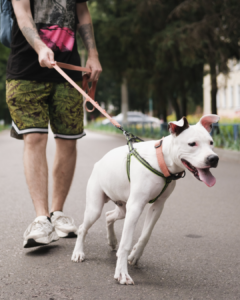
This Way

Let’s teach our dog to follow us when we cue, “This way.”

Say, “this way.” Turn 90 degrees off the path without pulling on the leash. Encourage your dog to follow. Praise warmly, then scatter three to five treats on the ground.

Practice “this way” several times during every walk, even when you don’t see other dogs or anything else that typically causes your dog to react.

We are teaching our dog that when something concerning appears, following us is safe and rewarding. Rather than barking and lunging, your dog learns to stay calm, follow you, and create distance.

I recommend turning at a right angle, either left or right, and moving off the path as far as you need. Sometimes that means walking up a neighbor’s driveway or sidewalk for a few moments. That’s okay. Your goal is to create enough distance for your dog to remain calm.

This way → increase distance → praise → scatter treats.

Under Threshold

When we actually encounter a trigger on a walk, such as another dog, our goal is to move before the barking and lunging begin. We call this working under threshold.

If I notice a trigger, I watch to see whether my dog has noticed it too. There is usually a brief moment after your dog sees the trigger but before emotion spills over into barking and lunging. That’s your opportunity.

Your dog sees the other dog. → “This way” → Move off the path, praise, and scatter treats.

Having practiced “this way” many times during ordinary walks, your dog will be much more likely to respond when it really matters.

Beyond Avoidance

Some people worry this is avoidance. It isn’t.

Your dog has seen the trigger. He knows it’s there. Instead of barking and lunging, he’s learning another response. He sees the trigger, follows you, earns reinforcement, and remains under threshold.

Over time, as your dog has many successful repetitions, he will naturally become comfortable at shorter distances from the things that once caused him to react. Walks become calmer, easier, and more enjoyable for both of you.

We’re not just trying to stop barking and lunging. We are teaching our dogs what to do instead.


Michael Baugh CDBC teaches dog training in Sedona, Arizona, Houston, Texas, and online everywhere. He specializes in aggressive dog training

Training Your Dog to Come When Called

Michael Baugh CDBC

Coming-When-Called (verb)

In response to a cue, the dog quickly decreases the distance from where they are to where you are, usually in a straight line, ending in front of you.

Reinforce this behavior every time it occurs.

Avoid asking for additional behavior, such as a sit, before reinforcing. Reward the come first. Everything else can wait.

The Sacred Promise

Many people tell me, “My dog will come if I say, ‘Treat!'”

Of course he will.

When you say “Treat,” you’re not lying to your dog. You fully intend to give him one.

So why not create that same certainty around the word “Come”?

Say, “(your dog’s name), Come!” Your dog runs to you. You give a treat. Every single time.

Come → Your dog comes → Treat.

That’s it.

The word Come should always mean the same thing: If you come to me, I’ll give you something.

Every time.

It’s a sacred promise.

And that’s the beginning of teaching a truly reliable come-when-called.

Simple, right?

Single-Rep Sessions

Throughout the day, randomly call your dog from another room.

Say, “(your dog’s name), Come!”

When your dog arrives, reinforce the behavior with a treat.

For best results, carry treats with you. If you don’t have one in your pocket, simply walk with your dog to where the treats are after he comes. That’s perfectly fine.

Then wait at least twenty minutes before calling him again.

Avoid practicing several repetitions in a row. Instead, teach in single-rep sessions scattered throughout the day.

Increase the Challenge

Once you and your dog are succeeding indoors, begin practicing outside.

Again, call once, reinforce. These are single-rep sessions.

If you’re not in a securely fenced area, use a long leash for safety.

The pattern never changes:

Come → Your dog runs to you → Treat. Every time.

Continue reinforcing this behavior throughout your dog’s life.

The goal isn’t to wean your dog off food reinforcement.

The goal is to build a recall so strong that your dog chooses you over squirrels, smells, other dogs, and every other competing motivator the world has to offer.

Few things in dog training are as satisfying as watching your dog sprint toward you full speed, eager, and joyful.

You’ll probably feel proud.

You’ll certainly feel more in control.

But my hope is that you’ll feel something even better: a deep connection with your dog.

That’s the best feeling of all.

That’s what you’ve been practicing for all along.


Micheal Baugh teaches dog training in Sedona, Arizona, Houston, Texas and online everywhere. He specializes in aggressive dog training. 
Dog Training is Experiential

Michael Baugh CDBC

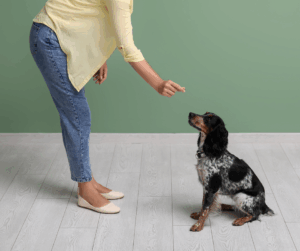
I can show you dog training techniques, the timing, the mechanics, the way your hands and body move. That part matters. You can learn a lot from dog training books, from articles, even from watching good trainers online. Those things help. But nothing replaces the experience of doing the work yourself.

Dog training is experiential. It isn’t something we do to our dogs. It’s something we do with them. We learn it in the same way they do: by trying, adjusting, and feeling it out as we go.

Mechanical Skills: Learning Through Movement

Effective dog training is physical. How we reach for the treat bag matters. The direction we turn our shoulders matters. Even whether we’re sitting, standing, or walking matters. Dogs see all of it.

Humans are natural imitators, so watching a skilled trainer can give you a great head start. But the learning really begins when you try it.

Your dog will teach you, too. Pay attention to how they respond to your movements, your posture, your facial expressions, even a small shift of your weight. These subtle cues shape the conversation between you and your dog.

There’s no perfecting this by reading alone. You only learn the dance by dancing.

Timing: The Art of Seeing the Moment

Good timing is all about the eyes. We reinforce as the behavior happens or just after, not minutes later, not even several seconds later.

That doesn’t mean you need to deliver the treat quickly. In fact, reaching for the treat bag too soon often distracts the dog. Instead, we use a marker like a clicker, or a consistent word that tells the dog, “Yes, you got it right, and your reward is coming.”

You can absolutely watch an experienced trainer do this. But great timing comes from practice. You build that skill rep by rep, moment by moment, until your marker feels almost automatic.

What About Board and Train?

People ask this a lot: “Can’t someone just train my dog for me?” We’ve all heard about the neighbor’s dog who went to “boot camp.” Some programs help; some cause real harm.

A positive-reinforcement board and train can give your dog a solid foundation. The most reputable programs require follow-up sessions so you learn how to continue the work at home. Take those seriously. Ask the trainer to coach you while you practice. Their expertise gets things started, but your involvement keeps it going.

Avoid trainers who rely on physical corrections, shock collars, or verbal intimidation. These so-called balanced dog training methods can damage a dog’s emotional well-being. And if you stayed with that approach, you’d be learning how to hurt your own dog. None of us brings a dog into our life to do that.

Training Together: The Real Reward

Training with your dog is a beautiful experience. It’s fun, sometimes messy, sometimes awkward, always deeply connecting. You’re learning about your dog while your dog is learning with you.

You’ve heard me say it before: training is communication. It’s one of the most meaningful conversations you’ll ever have with your dog.

So get in there. Try the thing. Allow yourself to feel uncoordinated at first. Work it out together. Keep going.

This is how great relationships form — through presence, effort, and shared experience. You bring your whole self, your dog brings theirs, and something remarkable grows between you.


Michael Baugh CDBC teaches dog training in Sedona, AZ and online. He specializes in aggressive dog training.