
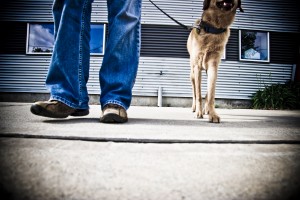
Taking the Pull out of Walks

Robyn Arouty Photography

It’s one of the most natural things in the world for us human beings, walking side by side.  Unfortunately it’s not at all natural for our dogs.  Rarely do they walk that way on their own.  When they do, it’s usually only momentarily.  That’s what makes teaching loose leash walking so troublesome for so many folks.

Add to that, when our dogs pull we often follow.  Dogs learn very early on that putting tension on the leash is just what they need to do to get where they are going.  We don’t set any limits and as a result we actually reward our dogs for pulling.

What we really want to do is reward our dogs for walking next to us.  I like to start off-leash (yes off-leash) in a safe enclosed area, like a fenced in back yard.  Start by walking around the yard casually at your own pace; don’t say anything to the dog.  As soon as your dog sidles up beside you simply say “yes” in a cheerful voice and offer him a special bit of food (cheese or boiled chicken is always nice).  Then, continue walking on silently.  When he comes up alongside you again, say “yes” again and deliver another treat.  Before long, you’ll notice that your dog is walking with you with that expectant doggie grin of his.  Keep saying “yes” and treating him until you can’t get rid of him.

All that’s left now is putting the leash on, right?  Well, that’s almost right.  Your dog will notice that things are different out in the wide world, and if he has a history of pulling he’s likely to fall right back into old habits.  Here’s what you need to remember.  If your dog pulls, stop.  No one makes any forward progress when the leash is taught.  Gently call your dog “this way” and begin walking the opposite direction with him.  Because you’ve changed direction you’ll find that for a moment he’s right beside you where you want him.  Say that magic word, “yes” and give him his special treat.  Now you’re playing the same training game you were playing in the fenced in yard.  The only difference is, you’re out front and the leash is on.

Let’s break this down, because your training really does need to be specific to work quickly.  Dog pulls: stop.  Change directions.  Dog beside you: “yes” and treat.  You may “yes” and treat multiple times so long as the dog is walking nicely beside you.  For the time being, all of your walks should be this kind of training walk.

Now for the ultimate reward.  What your dog really wants to do is sniff and explore.  So after a nice spell of walking by your side, smile at your dog and say “yes, go sniff.”  Then gleefully let him guide you around a bit for some doggie nose work.  It’s okay to let him pull for a short while in this context.  We call it a life reward.  The dog actually gets what he wants by giving you the behavior you want (walking nicely).  It’s  powerful reinforcement, with a proven track record.  It also happens to be the most natural thing in the world for your dog.

Houston Dog Trainer Michael Baugh, CPDT-KSA, CDBC specializes in behavior related to fearful and aggressive dogs.
 

Safe Departures for Separation Anxiety

(from All Things Dog Blog – Ask the Dog Trainer)

Dear Trainer:

We adopted our 10 year old Bichon 3 years ago, when his elderly owner became disabled. He settled in with us just fine immediately and became very attached to me. Shortly thereafter, he began whining incessantly upon my leaving, slobbering and licking the point of exit. We have returned to pools of slobber and scratched paint. He has even climbed a doggie gate in an effort to get to me.

Alix has a housemate, Toby, with whom he gets along well. However, only human companionship is soothing to his anxiety. Please help us teach Alix to calm himself so we may return without a distressed, slobber-sodden little dog.

Regards, Cathy

————————————————————-

Dear Cathy:

Dogs, like people, are social animals. We like to be around each other. Some folks would go so far as to say, we have a built-in need for social interaction. There’s something in the core of our beings that says relationships are important for our survival.

It’s not terribly common, but some dogs have pretty upsetting behavior when left alone. In some cases, it’s triggered by the departure of a specific individual….

(Read more)


Real Dog Training is Cool

photo courtesy: Robyn Arouty Photography

Michael Baugh, CPDT-KA, CDBC

Real Dog Training is cool.  Don’t get me wrong, some TV trainers are okay.  Victoria Stillwell was a real reward-based trainer before she got her own show, and that convertible of hers is pretty darn cool.  Rollerblading with bunch of dogs might be cool to some, but it’s not really my thing.  Pffsst!  Yeah, that’s not cool.

This is.  Today I made friends with a Shih Tzu who really didn’t like me at first (I’m pretty sure he wanted to bite me).  A few hours later I helped a woman potty train her beagle puppy.  That’s real dog training.  It’s not broken up into short segments between commercial breaks and problems aren’t resolved in an hour or less.  There are no short cuts with behavior; it takes time.  Real trainers do a lot of coaching, a whole lot of demonstrating and even more cheerleading.  We take care of our human and dog clients by making the process as clear and simple as possible.  We show people the magic of dogs without messing it all up with a bunch of mystical mumbo jumbo of our own.  Hello!  Cool.  Whispering?  That just makes it harder for people to hear you.

The truth is there isn’t much new in dog training.  Whoa, blasphemy.  What about clicker training (not terribly new) and all the new research coming out about dogs?  Okay, we are getting better every day at refining and applying behavioral science with dogs, but the basics remain the same.  I helped the Shi Tzu warm up to me with good old fashioned classical conditioning.  As for the beagle bathroom breaks, enter Dr. Skinner.  This stuff is old-school, well practiced, and thoroughly researched.  Real trainers teach it with vigor and style, yes.  But we don’t have to dress it up to make it cool.  It just is cool.

So why are so many trainers trying so hard to be the next latest and greatest thing?  I recently read about a new age celebrity trainer in Hollywood.  Her web site was chakra rocking and chi wheeling.  Her uber cool movie star clients apparently loved her.  But I had to wonder, with all this spirit, where the substance was.  She was beautiful; and she sold the enigmatic charm of dogs oh so well.  But could she really teach and train?  Scan the internet (okay maybe you shouldn’t) and look at all the trademarked methods for dog training.  They’re making things up and busting other stuff left and right.  Instant results and guarantees are in vogue, while the “how to” is a bit vague.  Sure the “Baugh Method” would boost my ego.  But seriously, it’s just silly (the abbreviation is awkward, too).    What’s wrong with the Pavlov method, or the Skinner Method, even the Breland and Bailey method?  Maybe it just doesn’t sound cool.  I don’t know.

I guess it’s all just a matter of perception.  If you’re a behavior geek who knows the difference between ABA and ABBA (and perhaps appreciates both) it boils down to this.  You’re still a geek.  On the other hand, if you are attractive and skate well you get your own “way.”  Maybe you can tap into our human need for mysticism and talk about flow and energy.  That’s the stuff.  Then, you’ll have that certain something that all the popular kids in high school had.  No one could define it, but it didn’t matter.  They were cool.

I keep thinking of Alex.  He was a 7 month old lab mix and a hard-core play biter.  I use the term loosely.  He wasn’t playing, he was demanding attention.  Chomp – Ouch!  It hurt something fierce.  The night I met him I laid out a training plan and left bleeding.  I hoped against my angst that his family would follow through and follow up.  If they didn’t, Alex was on fast track to disaster.  There was no glamor that night, no cameras and no quick fixes.  I was tired from a long day and I smelled bad.  I called a trainer friend while I tried to hold back my own doubts.  “I just stuck to the basics.” I said, “It has to work right?” He’s a cool guy.  He assured me it would.

Alex’s family applied The Skinner just as I’d shown them.  They were precise and tireless.  They charted Alex’s time-outs (negative punishment) and watch them decline steeply.  They taught Alex some amazing good manners (positive reinforcement) with skill and masterful timing. The punctures and scratches and bruises faded as their success grew.  They called almost daily with reports.  We kept things on course, and when it was time we celebrated.  I beamed with pride and told them they were my heroes, because they are.

Sometimes clients (or potential clients) ask me if I’m like “The Dog Whisperer.”  They want to know about becoming their dog’s Alpha and earning his respect.  Some ask if I use this method or that, if I can break this or that.  I guess it’s the litmus test of coolness.  I do my thing, just a regular reward trainer trying to keep it real.  Sure, it gets tough sometimes.  There are a lot of other trainers who are much slicker.  I get it.  Then I think of Alex and his family, happy and hanging out watching TV.  They’re just regular folks and he’s just a normal relaxed dog.  They worked the process and the process worked for them.

Okay, yeah.  That’s way cool.