
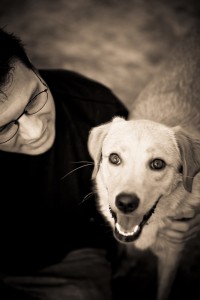
Stella at Two

Robyn Arouty Photography

Michael Baugh, CPDT-KA, CDBC

There was a night I feared she would not survive.  She was twitching incessantly and crying inconsolably.  We knew her disease was often fatal, but she had to survive.  We’d only had her a few weeks, but already she was ours.

Something magical happens when a dog turns two, especially a retriever.  She is young but no longer a puppy.  She is socially mature but not yet old.  The bonds she forged in the months prior become solid.  All that she’s been taught, including the ability to learn, takes hold.  And, she takes on the quiet wisdom that is the signature of her kind, the very best of her kind.  She comes into her own.

Our dear Stellla is imperfect and quirky, undoubtedly.  She stands nearly as tall as she is long.  That counts for something because her height and length are each considerable in measure. She is equally lithe and narrow.  She is a leggy strawberry blond.  Add to that her twitch, constant and rhythmic, as if she were keeping time to a song no one else can hear.  Stella is, well, odd and cartoonish and beautiful.

To be certain she is not a classic beauty like the Goldens and Labs in her genetic buffet.  Hers is the beauty of movement, grace at an open run, the leap and grasp at a thrown ball, the dance of play with her own kind, strength and inhibition in equal measure.  Stella is the gangly egret at rest, arresting beauty in flight, the gasp and the awe.   Even when resting she is never still.  Only her eyes hold fast, a lasting gaze with a subtle wink just before they close and carry her away to sleep.

Something magical happens when a dog turns two, especially Stella.  She is breathtaking in the way so many normal dogs are.  This is, with certainty, because of who she is.  She is a dog, imperfect and beautiful and that’s enough.  But, she is so much more.  She is ours.  We plucked her from death in a cage at a shelter and claimed her.  She peed at our feet and shat and barked and we loved her just the same.  She twitched in my arms and cried late into the night, fighting a virus none of us could see.  I cried with her and loved her imperfectly.  We were reflections of each other, the best of all that is dog and all that is human, goodness from each in equal measure.

Stella turned two today, our magical dog.  Tonight she will rest by my side.  I’ll watch her ear twitch as she falls into a deep refreshing sleep.  She never stops moving, not ever.
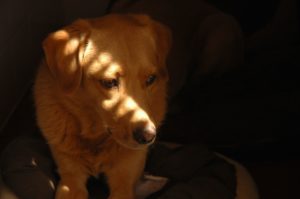
The Truth About Canine Aggression


Michael Baugh KPA-CTP CPDT-KSA CDBC

“Your dog isn’t dominant; he’s frightened.”  I say that to clients who have dogs with aggressive behavior more often than you might think.  People are surprised, and many are relieved.  The dog isn’t being mean to take control.  He’s just trying to make something frightening go away or stop.

Understanding that leads to a fundamental shift in how we approach dogs who are behaving offensively.  If a dog is afraid, it doesn’t help to assert our own authority (often with some aggressive behavior of our own).   It helps much more when we teach the dog how to behave calmly under pressure.  Better yet, let’s teach our dog that the thing he’s afraid of isn’t so scary after all.  Now, there’s the challenge.

I see a lot of dogs who are afraid of people they don’t know, men in particular.  Sometimes this fear is a result of trauma or abuse.  More often, there was a lack of socialization with people in the dog’s early development.   Whatever the cause, dogs will try to create distance between themselves and the thing they perceive as frightening.  Some dogs increase that distance by running away or hiding.  Others, the ones we call “aggressive,” try to increase distance by making the scary thing go away.  They bark, growl, snarl and lunge.  Some bite.  Regardless, the goal is the same:  Make the scary thing stop. (A person reaching for a dog will pull back when a dog growls).  Or, make the scary thing leave (dog growls – person retreats – dog is relieved).

In most cases, like the example above, dogs who are behaving aggressively are trying to avoid something.  Specifically they are avoiding close contact or interaction with something that scares them.  Cases in which the dogs are aggressive to attain something are rarer.  Most of those situations involve predatory behavior, in which a dog is chasing an animal or a person who is running away. Dogs who guard their food bowls and toys are somewhere in the middle.  They are trying to keep a resource.   Though some would say they are afraid of losing that resource, which brings us back to fear.

In the end, teaching your dog that the world is a safe place is your responsibility.  So is training your dog to behave attentively and calmly in the presence of frightening things.  Calm resolve and a focus on upbeat reward-based training is the key to success.  Of course, there is help available.  And, finding the right kind of help is absolutely essential.

Dog Behaviorists and Dog Behavior Consultants are qualified to assist people with dogs who exhibit aggression.  The person you choose should be very familiar with applied behavior analysis and desensitization / counter conditioning techniques.  Avoid trainers who use force to suppress behavior, or who insist you assert yourself as your dog’s “alpha.”  That could just lead to more fear and unwanted behavior.  Remember, he’s not trying to take over.  He just wants to feel safe, and to know that you’re there to help show him the way.

Houston Dog Trainer Michael Baugh CPDT-KSA, CDBC specializes in cases of canine fear and aggression.

Helping a Dog Meet Baby

Michael Baugh, CPDT-KA, CDBC

Dear Michael:

My daughter has a 4 month old baby. Since his birth, my tiny dog has been nothing short of a nightmare around him. He wants to get close and lick him and play with him. The more we restrain him the more he cries, pants, and barks. We dare not let him anywhere near the baby unless we have him by the collar. He doesn’t bite, just licks and prods. He is fine with toddlers we meet in the street. How can we have the baby in the house without our little dog causing such exasperation?
Recently things have improved very slightly.  Whilst he is still uber uber interested in him, he now lies beside him, suffering all the involuntary arm and leg prods and jerks from the baby and rests his head on baby’s legs (when he is still, which isn’t often!).  He seems to have been wanting to be very close to him all this time and of course we were prohibiting that.  He is, it goes without saying, always supervised.
Cathy
—————————————————-
Dear Cathy:
Babies are unusual creatures to many of our dogs (and to many of us for that matter).  They move differently than adult humans.  They sound different and smell different.  From our dogs’ point of view they are new and unusual, weird even.  It sounds like your daughter’s dog is a bit nervous about the baby, or at the very least excited.  We need to help him out.

You have two goals here.  First, teach the dog that babies are cool.  Try very hard to never yell at or hurt the dog when the baby is around.  That’s only going to make things worse.  In fact, only delightful things should happen when the baby is on the scene.  If the baby does something weird, like scream and wiggle like a fish, you might even slip the dog a special treat.  That’s called respondent conditioning (classical conditioning).  Baby = good things for doggie.  The idea here is to make sure the dog doesn’t start disliking the child because being around him is so awful.