
Children and Dogs

Guest Blogger, Curtiss Lanham CPDT-KA

Children and dogs: what a beautiful image that our minds immediately race to. The ‘Timmy and Lassie’ portrait is quickly conjured up…and they lived happily ever after. Not so fast…

The interesting thing is that kids don’t come pre-progrmmed to know how to interact properly with dogs, any more than dogs come pre-programmed to interact properly with kids. Read: adults now have to step-in and do something positive to ensure they do live happily ever after. So what can we adults do to ensure that our kids and our dogs will get along safely and happily? Here are three areas that we can concentrate on in this effort: Training-Socialization-Supervision

Training our Children

  • To respect the dog’s space, food and toys
  • To not treat the dog as a toy: don’t pull ears/tail/paws/nose, don’t ride the dog, don’t pull the dog around by it’s collar
  • To refrain from hugging dogs around the neck or put their face into the dog’s face
  • To refrain from screeching, screaming and squealing at the dog
  • To play ball, fetch, etc., but ONLY under adult supervision.

Training our Dogs

  • To know that children bring happy, fun things and are pleasant to engage with.
  • To trust that only good things happen with children
  • To respond to requests (sit, down, come, etc.) when asked by children so that they can communicate effectively together and strengthen their relationships
  • To understand the expectations of the household they live in

Socialize our Children

  • To dogs at an early age and expose them to a variety of breeds often and safely, but ONLY under adult supervision.

Socialize our dogs

  • To children at an early age (3 weeks to 3 months of age, if possible). Expose them to a variety of children often and safely, but ONLY under adult supervision. These meetings must always have a ‘happy ending’ for the puppy and the child.

Supervise

  • All interactions between children and dogs
  • Be watchful to ensure the children do not mishandle/mistreat the dog
  • Be watchful to ensure the dog is not stressed during the encounter: Stress signals may include some/ all of the following: yawning, lip licking, turning head/eyes away, lowering head/ears/tail, slinking away, crouching/hiding. Distance increasing signals by the dog may include some/all of the following: lip lifting, low growl, snarling, showing teeth, air snapping, etc. If any of these are observed, end the session immediately, quietly and calmly exit the child from the dog. Refrain from punishing the dog.
  • Ensure proper meet/greet by child
  • If you cannot supervise then exit the child from the dog so there is no possibility of improper encounter by either the dog or child

By putting this plan into action with your children and dogs your family will be on the road to loving, safe relationships. Relationships that transcend even the ‘Lassie and Timmy’ connection!

Houston/Katy Dog Trainer Curtiss Lanham, CPDT-KA is the co-owner of dogsmart, a Fulshear based canine behavior counseling and training group.
Look and Listen

MICHAEL BAUGH CPDT-KA, CDBC

HOUSTON – A lot of people think their dog has selective hearing when it comes to basic obedience cues, especially coming when called.  No matter how many times they call their dog, it seems he’s just not listening.  Some folks even worry their dog may be ignoring them out of spite.  Fortunately, that last one probably isn’t true.  He just hasn’t been trained yet to tune into you when you call.

It turns out the key to really effective dog training isn’t so much about listening.  It’s about teaching your dog to look at you.  Dogs who are keeping their eyes on you are also keeping their ears attuned to what you are saying.  In fact, most precision obedience training is really about the dog’s visual attention, not his listening.  Dogs actually learn visual cues (hand signals) more easily than they learn verbal cues (words).

Start at the beginning.  The first thing I recommend people teach their dog is eye contact.  It’s important that dogs learn to focus their attention on our faces.  It sets them up to catch our verbal instructions on the first go around.  It also allows them to better read our facial expressions for feedback on how they’re doing (dogs are experts at reading human facial expression, even subtle change in our expressions).

Here’s how to do it.  Keep some of your dogs kibble in your pocket.  Every time you catch him glancing up at your face say “yes.”  Then, immediately follow up by giving him a piece of his food.   This is called capturing a behavior.  In a short time, your dog will be watching you all the time regardless of whether or not you have food on you.  Once you he’s doing that you can start calling his name (only say it once please).  When he responds to his name with a look up to your face, immediately say “yes” and treat him.  Repeat this often so that his name becomes like a magic word that draws your dog’s attention to you immediately every time.

Before long your dog will be glued to you, watching attentively for further instructions.  Your friends will all say, “Wow he really listens.”  Of course you’ll smile and agree, because you know he’s looking at you.


(from myfoxhouston.com)

Swim Stella, Swim!

Michael Baugh, CPDT-KA, CDBC

“This dog can’t swim.”  That’s what I thought as I watched her struggle, bob and tip in the pond.  I was about to jump in the murky water myself when I saw Stella briefly roll onto her back and then right herself.  She stepped gleefully to the shore, shook off, dropped her ball, and looked up at me.  She had no idea how pathetic she had looked.

Of course, I was concerned.  Stella had swum before, albeit briefly.  But, this last time was different.  Physics failed her.  She listed to one side, nearly sank, and then went keel up. She was wholly out of her element, and I’d so wished her element was water.  I wanted it badly; I wanted it with every memory of the retriever before her, with every hope of the retriever I dreamt she would become.  That was the problem.  This wasn’t about me.  It was about Stella; and Stella couldn’t swim.

I tried to get my brain around it.  Maybe it really was bad physics.  Stella’s chest is unusually deep and her waist is unusually small.  She’s narrow, very narrow.  She’s tall and long, unnaturally so.  Her face and coat say retriever, but the rest of her says whippet or Italian greyhound.   Okay if I’m going to be brutally honest, if you catch her at the wrong angle the whole package screams “cartoon dog.”  Maybe her body just wasn’t built for water; maybe she was too lean, too spindly.  Maybe she just couldn’t swim.

When my heart’s breaking, I write.  So, I wrote some veterinarian friends of mine.  No, they said.  There’s nothing wrong with Stella.  She is quirky beautiful and fully buoyant.  I wrote to a local dog swim coach (who knew?) and she said the same thing.  Some dogs are naturals, others are not.  Stella can learn.  She can swim.

I can’t explain what happened next.  Sometimes there’s no way to fix a thing set askew.  Then again, sometimes there’s no holding back a thing intent on setting itself right.  Stella’s new coach is an affable woman in the middle of life, with an easy smile and a gentle feel for a dog’s spirit. She welcomed us to a long glistening pool in the early light of day.  “Does Stella like toys?” she asked.  “Tennis balls” I answered.  The rest was unstoppable.  It was the simple magic of letting things happen, letting go, swimming with the current of the moment.

Stella waded into the pool for her ball, and brought it back.  On the second throw, she leapt across the shallow slope into the deep.  Stella’s head slipped under and then popped up high in the water, a bow splashing and awkward, and a stern dragging too low.  Her coach moved with deft purpose, the subtle speed of a woman who knows her craft.  She righted Stella’s hips, bringing them level to withers just below the water’s crest.  Stella sailed with ease back to the shallows and out.  She dropped the ball and looked back at what she’d swum.

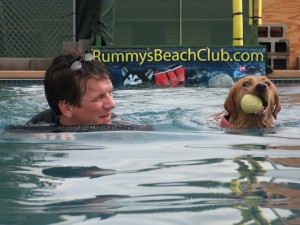
courtesy: Rummy's Beach Club

I threw again.  Again she leapt and swam.  Again, and again Stella’s body stretched, and her head skimmed the break where water meets air.  Her legs tucked naturally, fronts propelling, backs adjusting for balance.  She used her thick retriever tail like a rudder.  Stella leapt and swam.  She moved with ease and grace, ball firmly in mouth, eyes gleaming in the morning sun, nowhere to be but here, nothing in mind but now.  Stella leapt again and then swam some more.  She panted and pushed hard against the water, a wake behind her.  The air was sweet with the smell of wet dog and abandon.  I moved up beside her and kissed her cheek.  I would have loved her the same no matter, but oh how I love my water dog.

We stayed on like that until we were both soaked through, swimming together.