Myth Busting Clicker Training

Michael Baugh CDBC

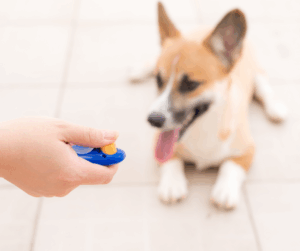
I’ve clicker trained for a long time, and I can honestly say it remains one of the most impactful tools I teach my clients. If you have used it yourself, you know what I mean. If you haven’t tried it yet, I can’t wait for you to experience how fast dogs learn with it.

Clicker training works because it gives the dog an immediate, consistent signal that marks exactly the behavior you want them to repeat. The click is not a command, it’s not the treat itself, and it certainly does not make the dog behave on its own. It simply tells the dog, Yes. That was the right behavior and then you follow it with food reinforcement. Dogs learn because that click reliably predicts something great is coming. This kind of immediate feedback dramatically accelerates their understanding of what you’re asking for.

One of the first things clients notice when they pick up a clicker is that it changes their timing and focus. When you are concentrating on clicking at that exact moment you see the correct behavior, it naturally hones your observation skills. Many people find themselves less likely to dive into the treat bag too early. They are watching, clicking, and then treating.

There are some common myths about clicker training that I want to clear up because they often keep people from giving it a real shot. One of the biggest misconceptions is that you have to have the clicker with you all the time, or else your dog will forget everything they learned. That could not be further from the truth. Clickers are tools for the learning phase of a behavior. Once a task becomes fluent and reliable, you can set the clicker aside. Your dog will still perform the behavior; they just don’t need the marker anymore. You might still reinforce with treats or praise periodically, but the clicker itself is retired for that command.

Another myth is that the clicker makes the dog perform. Some people think the sound of the clicker somehow causes the dog to behave. That misinterpretation leads to confusion, especially when a dog doesn’t respond without the clicker in hand. In reality, the clicker teaches the dog to understand exactly what behavior earned reinforcement. It’s a marker. A bridge. A communication shortcut. Nothing more, nothing less.

Some trainers worry that dogs will be dependent on constant clickers and treats forever, but that is also incorrect. Once the behavior is strong, predictable, and reliable, you can begin to thin the rewards. The power of clicker training is that once the learning has happened, the dog remembers the behavior without holding you hostage to the tool.

The bottom line is that clicker training is  science-based, positive reinforcement dog training that fosters fast learning, clear communication, and a strong bond between dog and handler. It’s not magic, but it sure feels like it when an “aha” moment clicks for both you and your dog.

Michael Baugh is a dog trainer in Houston, TX. He specializes in aggressive dog training.
Change (The Nature of Dog Behavior)

Michael Baugh CDBC CPDT-KSA

Our dogs’ behavior changes. That’s good news, and it is bad news. Behavior changes in ways we want it to. Think: training. Our dogs’ behavior changes in ways we don’t want it to as well. Think: why is he suddenly barking at visitors?

Our dogs are always learning from us, from others, and from their environment. Changing behavior is inevitable. It is part of nature, like gravity and the rising sun.

One of my favorite authors, Octavia Butler, wrote: “The only lasting truth is change. God is change.” (Parable of the Sower). That might not set well with some of my readers. So, think of it metaphorically. Change is the one constant, from animals to plants to the landscape itself. Everything changes. For believers, it would be hard to ignore the hand of God in all that. For nonbelievers, it is awe-inspiring nonetheless.

Change, specifically the promise of changing behavior, inspires my work with you and your dogs. Of course, change is frightening sometimes. (Why is this happening? It hasn’t happened before.) I choose to look at change with wonder. (Look at what is happening now. This is new. How cool.)

“All that you touch, you change. All that you change changes you.” That’s Octavia Butler, too. We influence change because we are part of this living world. We certainly influence changes in our dogs’ behavior. I see that every day in my work and in my own home. It’s a marvel if you think about it.

My dog Charlie is a champ at coming when called and he loves lying on his mat. He’s also taking on air travel, long road trips, and hikes up desert rocks (no small challenge for a three-legged dog).

On the surface, it looks like nothing more than cues and treats. That’s part of dog training, yes. But zoom out. Change begets change. The little ways we set up our dogs’ world can have huge positive effects. How can we change the settings we create for them? What slight changes can we make in our own behavior to make learning easier for our dogs? Where can we change things to ensure our dogs’ success?

Join me this new year in embracing change. Some of it is scary. I get it. Much of it, most certainly the behavior change work we do with our dogs, is waiting with joy and surprise. Teach. Love. Teach again. Love some more. Marvel at the change. Our dogs are changing. We, too, are changing.

“God is Change — Seed to tree, tree to forest; Rain to river, river to sea; Grubs to bees, bees to swarm. From one, many; from many, one; Forever uniting, growing, dissolving — forever changing. The universe is God’s self-portrait.” Octavia Butler.


Michael Baugh specializes in aggressive dog training in Houston, Texas.

Dog Behavior – What I Learned from Animals on The Galápagos Islands

Michael Baugh CDBC CPDT-KSA

On about the 5th day of our trip it occurred to me that The Galápagos Islands are one of the few places on earth where everything is still as it should be. There are very few humans. We fish there, but not too much. Birds and large mammals, like the sea lions, are mostly safe from us. We haven’t crowded the animals out or paved everything over. There are a few towns and two small airports. There are small ports and motorized boats. Still, in most ways the animal inhabitants of The Galápagos live as they have for hundreds of years.

What happens when animals live with relatively few pressures from human beings? This is my opinion as a matter of experience. They thrive. This appears in their physical and reproductive health. It also shows in their behavioral health. Because of strict conservation laws, humans are not allowed to hunt or harass animals on the islands. As a result, many are very trusting of us – friendly, in fact. Curious juvenile sea lions routinely approached us on the beach and in the water. Penguins swam up to us and around us, sometimes within inches. Iguanas tolerated our clumsy trodding over them. Birds flew and landed nearby. Giant tortoises plodded along with nary a notice. These are animals under absolutely no pressure from humans. I daresay they are better for it – happier.

It got me thinking about our dogs. The hard truth is we put our dogs under a lot of pressure. Even the Belgian Malinois at The Galápagos airport on Baltra is under pressure. Say on a leash. Stay in a crate. Climb the luggage and sniff for contraband. Meanwhile back in Houston we insist our dogs answer our every command. Stay alone for hours on end. Move at our pace on walks. Meet who we want them to meet when we want it, including other dogs. All the while remain friendly. Never express an emotion unless it’s one of the ones we like. Behave this way in public, in crowds, wearing a harness and a leash and silly clothes.

What if we just let our dogs be dogs? Would that be enough for us? Aren’t they already enough? What if our influence on them was light and kind? What if they got a fraction of the empathy and respect we were required to show the sea lions on the beaches of The Galápagos? Our dogs are noble animals. They are not toys. They are not Disney characters. They’ve evolved with us. They are uniquely suited to live with us. But, our life with them is not all about us. This isn’t all about us.

Human beings, Homo Sapiens, have walked the earth for about 300-thousand years. Only in the past 500 or so years did we really start to spread. Whalers stumbled upon The Galápagos in the early 1500’s. The industrial revolution started just 200 years ago. Two hundred years is very recent compared to 300-thousand. I’ve often said to clients that we humans have already won the evolutionary race. We inhabit every bit of the earth. For better or worse, we’ve won.

I stood on a beach no one had walked on since the last high tide. I could see stingrays and eagle rays in the surf. Bright orange crabs clung to the lava rocks. A green sea turtle crawled out of the water. Giant frigate birds, broad-winged but barely 2-pounds in weight, floated above. This is where everything is still as it should be,  I thought. It wasn’t that long ago that the whole planet was like this, 400 years ago, 500. What happened? When did we decide it was all ours and only ours?

For many of us, our dogs are our only real connection to the natural world. That’s a lot of responsibility for one species. It’s even more responsibility for us. I’m in the business of helping people teach their dogs. But I wonder. What could we learn from our dogs, or from the squirrel, or the cardinal, or the possum, those fragments of the wild that remain? What could they teach us about ourselves?


Michael Baugh teaches dog training in Houston, TX. He specializes in behavior related to fear including aggressive behavior.