
Myth Busting Clicker Training

Michael Baugh CDBC

I’ve clicker trained for a long time, and I can honestly say it remains one of the most impactful tools I teach my clients. If you have used it yourself, you know what I mean. If you haven’t tried it yet, I can’t wait for you to experience how fast dogs learn with it.
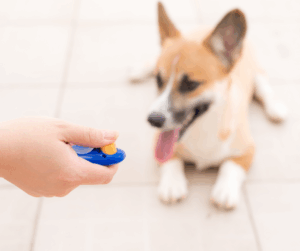
Clicker training works because it gives the dog an immediate, consistent signal that marks exactly the behavior you want them to repeat. The click is not a command, it’s not the treat itself, and it certainly does not make the dog behave on its own. It simply tells the dog, Yes. That was the right behavior and then you follow it with food reinforcement. Dogs learn because that click reliably predicts something great is coming. This kind of immediate feedback dramatically accelerates their understanding of what you’re asking for.

One of the first things clients notice when they pick up a clicker is that it changes their timing and focus. When you are concentrating on clicking at that exact moment you see the correct behavior, it naturally hones your observation skills. Many people find themselves less likely to dive into the treat bag too early. They are watching, clicking, and then treating.

There are some common myths about clicker training that I want to clear up because they often keep people from giving it a real shot. One of the biggest misconceptions is that you have to have the clicker with you all the time, or else your dog will forget everything they learned. That could not be further from the truth. Clickers are tools for the learning phase of a behavior. Once a task becomes fluent and reliable, you can set the clicker aside. Your dog will still perform the behavior; they just don’t need the marker anymore. You might still reinforce with treats or praise periodically, but the clicker itself is retired for that command.

Another myth is that the clicker makes the dog perform. Some people think the sound of the clicker somehow causes the dog to behave. That misinterpretation leads to confusion, especially when a dog doesn’t respond without the clicker in hand. In reality, the clicker teaches the dog to understand exactly what behavior earned reinforcement. It’s a marker. A bridge. A communication shortcut. Nothing more, nothing less.

Some trainers worry that dogs will be dependent on constant clickers and treats forever, but that is also incorrect. Once the behavior is strong, predictable, and reliable, you can begin to thin the rewards. The power of clicker training is that once the learning has happened, the dog remembers the behavior without holding you hostage to the tool.

The bottom line is that clicker training is  science-based, positive reinforcement dog training that fosters fast learning, clear communication, and a strong bond between dog and handler. It’s not magic, but it sure feels like it when an “aha” moment clicks for both you and your dog.

Michael Baugh is a dog trainer in Houston, TX. He specializes in aggressive dog training.

How to Prepare For Your Dog Training Session

Michael Baugh CDBC

Dog training on-the-fly can look too much like testing and not enough like teaching. Sure, there are some circumstances where a properly reinforced single-event training moment is acceptable, even preferred (example: randomly calling your dog to you for a click and treat). Most of the time, though, I recommend well-planned brief sessions for training with your dog, seven to ten minutes in duration, one to three times per day.

What Should You do Before Starting a Dog Training Session?

✅ Make sure you have all the props you’ll need nearby. (for example, your dog’s mat, or target stick)

✅ Have treats and your clicker if you are using one. (Carry your treat bag around for an hour before a session so your dog doesn’t automatically flip into “training mode.”)

✅ Create a low-stress, minimally distracting place to train.

✅ Imagine what a successful session will look like. Visualization works.

✅ Take a breath. Relax. I like to do a brief meditation before training. It helps me focus and pay attention.

Begin.

When we set ourselves and our dogs up for success, training is fun. It’s not always easy, but the challenges are easier to solve. Enjoy this moment. Keep in mind how your session connects to your larger dog training goals without getting lost in the future, or getting frustrated because you’re not there yet. Teach in the here and now. The days with your dog are passing, and this is all part of the joy you share with each other.


Michael Baugh teaches dog training in Houston TX. He specializes in aggressive dog training.

Change (The Nature of Dog Behavior)

Michael Baugh CDBC CPDT-KSA

Our dogs’ behavior changes. That’s good news, and it is bad news. Behavior changes in ways we want it to. Think: training. Our dogs’ behavior changes in ways we don’t want it to as well. Think: why is he suddenly barking at visitors?

Our dogs are always learning from us, from others, and from their environment. Changing behavior is inevitable. It is part of nature, like gravity and the rising sun.

One of my favorite authors, Octavia Butler, wrote: “The only lasting truth is change. God is change.” (Parable of the Sower). That might not set well with some of my readers. So, think of it metaphorically. Change is the one constant, from animals to plants to the landscape itself. Everything changes. For believers, it would be hard to ignore the hand of God in all that. For nonbelievers, it is awe-inspiring nonetheless.

Change, specifically the promise of changing behavior, inspires my work with you and your dogs. Of course, change is frightening sometimes. (Why is this happening? It hasn’t happened before.) I choose to look at change with wonder. (Look at what is happening now. This is new. How cool.)

“All that you touch, you change. All that you change changes you.” That’s Octavia Butler, too. We influence change because we are part of this living world. We certainly influence changes in our dogs’ behavior. I see that every day in my work and in my own home. It’s a marvel if you think about it.

My dog Charlie is a champ at coming when called and he loves lying on his mat. He’s also taking on air travel, long road trips, and hikes up desert rocks (no small challenge for a three-legged dog).

On the surface, it looks like nothing more than cues and treats. That’s part of dog training, yes. But zoom out. Change begets change. The little ways we set up our dogs’ world can have huge positive effects. How can we change the settings we create for them? What slight changes can we make in our own behavior to make learning easier for our dogs? Where can we change things to ensure our dogs’ success?

Join me this new year in embracing change. Some of it is scary. I get it. Much of it, most certainly the behavior change work we do with our dogs, is waiting with joy and surprise. Teach. Love. Teach again. Love some more. Marvel at the change. Our dogs are changing. We, too, are changing.

“God is Change — Seed to tree, tree to forest; Rain to river, river to sea; Grubs to bees, bees to swarm. From one, many; from many, one; Forever uniting, growing, dissolving — forever changing. The universe is God’s self-portrait.” Octavia Butler.


Michael Baugh specializes in aggressive dog training in Houston, Texas.