Resolving Dog Reactivity by Teaching “This Way”

Michael Baugh CDBC

What are we trying to teach dogs who bark and lunge at other dogs, people, bikes, or cars on walks?

We call them “reactive dogs.” But what are we trying to replace that reactivity with?

Not simply the absence of barking. We want a dog who calmly follows our lead.
This Way

Let’s teach our dog to follow us when we cue, “This way.”

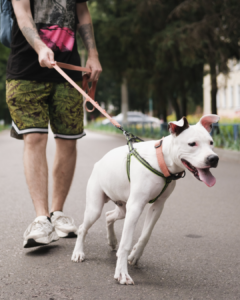
Say, “this way.” Turn 90 degrees off the path without pulling on the leash. Encourage your dog to follow. Praise warmly, then scatter three to five treats on the ground.

Practice “this way” several times during every walk, even when you don’t see other dogs or anything else that typically causes your dog to react.

We are teaching our dog that when something concerning appears, following us is safe and rewarding. Rather than barking and lunging, your dog learns to stay calm, follow you, and create distance.

I recommend turning at a right angle, either left or right, and moving off the path as far as you need. Sometimes that means walking up a neighbor’s driveway or sidewalk for a few moments. That’s okay. Your goal is to create enough distance for your dog to remain calm.

This way → increase distance → praise → scatter treats.

Under Threshold

When we actually encounter a trigger on a walk, such as another dog, our goal is to move before the barking and lunging begin. We call this working under threshold.

If I notice a trigger, I watch to see whether my dog has noticed it too. There is usually a brief moment after your dog sees the trigger but before emotion spills over into barking and lunging. That’s your opportunity.

Your dog sees the other dog. → “This way” → Move off the path, praise, and scatter treats.

Having practiced “this way” many times during ordinary walks, your dog will be much more likely to respond when it really matters.

Beyond Avoidance

Some people worry this is avoidance. It isn’t.

Your dog has seen the trigger. He knows it’s there. Instead of barking and lunging, he’s learning another response. He sees the trigger, follows you, earns reinforcement, and remains under threshold.

Over time, as your dog has many successful repetitions, he will naturally become comfortable at shorter distances from the things that once caused him to react. Walks become calmer, easier, and more enjoyable for both of you.

We’re not just trying to stop barking and lunging. We are teaching our dogs what to do instead.


Michael Baugh CDBC teaches dog training in Sedona, Arizona, Houston, Texas, and online everywhere. He specializes in aggressive dog training

Aggressive Dog Training – Keep it Light and Fun

Michael Baugh CDBC

I don’t remember who it was. A mentor many years ago said, “Aggressive behavior is just behavior.” It plays by the same rules of behavior just like anything else our dogs do.

It’s true. Behavior that is reinforced (think: behavior that works) grows stronger and comes back time and time again. But aggressive dog behavior is distinctly different because powerful emotions fuel it. Aggression works; barking and biting make things stop. And aggression is born of fear turned to anger. Emotionally charged behavior comes up fast and has a kick behind it.

We can replace aggressive behavior with cooperation, more benign tasks and patterns our dogs can follow. New people in our home, for example, can trigger calm and attentive behavior rather than barking and menacing. There’s training for that.

More importantly, though, we can quell the fear and anger behind the aggression. It’s not all about throwing treats at the dog, either. Yes, food plays a role. But there is something else even more powerful at play. You and me. How we behave around our dog when things get tense — that is critical.

Here are some facts. Dogs watch us. They understand our facial expressions. They. notice and respond to our body postures, vocal tones, and some words. Our dogs look to us for social feedback and support. They are social creatures. So are we. Dogs and we have co-evolved for thousands of years. This next part is really cool. Dogs frequently mirror our emotions (and we there’s, I suspect). Model calm behavior for your dog, and you are more likely to see a calmer dog. Act excited and talk in a cheerful voice, and see your dog get bouncy and excited.

I like to keep all training fun and easygoing because I know it helps my dog learn. How we show up in the moment matters. Take a few deep breaths before you start. Let your shoulders relax. Smile. This is especially important when we are working with a dog who has an emotional injury. Our fearful dog (and angry dog) needs a human teacher who is confident but calm, and most of all kind.

If you have a long-standing good relationship with your dog, you are already in an excellent position to succeed. Your relationship counts for more than you might think. You might use clicker training (a mechanical clicker or tongue click) to teach your dog new skills and patterns of behavior. Good. But don’t forget your most powerful advantage: yourself. Learning is not all about the clicks and treats. Leverage your relationship. Include yourself, your gentle words, your reassuring presence. It all counts.

Include play. Take a break for some tug or retrieve. Spend a moment or two between reps to enjoy some goofy time.

Share some joy. Soak some in for yourself. The days we have with our dog are passing quickly. Don’t let them go unlived. Aggressive behavior is serious business. The training to ease it doesn’t have to be.

Michael Baugh CDBC teaches dog training in Sedona AZ and Houston TX. He specializes in aggressive dog training.