Stop Shoulding on Your Dog (and yourself)


Michael Baugh CDBC CPDT-KSA

We are trapped in a toxic relationship with “Should” and “Shouldn’t.” That is to say, we are trapped in our own heads with our own worst critic – ourselves. So it’s no surprise that we project that emotional poison onto our dogs.

He should come when I call him.

She can bark at the door but she should calm down when I tell her it’s a friend.

He shouldn’t growl … jump … lick … bite … move.

“Should” and it’s ugly cousin, “Shouldn’t,” are hurtful to us and potentially dangerous for our dogs. “Should” and “Shouldn’t” prowl the borders of  what we’ve dreamt our dog would be, what we’ve wanted him to be, perhaps even before he was born. We wished for a loving companion, a champion, a supportive friend, loyal, reliable, smart, like in the movies. When we actually have a dog we find ourselves very much in the real world of what he is and is not. Perhaps our dog really is loving to us and smart, but not so reliable when it comes to strangers. Maybe our dog scares people and sometimes bites. The parts we dreamt of that overlap with reality (loving and smart) feel good. The parts that don’t line up (reliable, for example) cause us to suffer. In fact, the greater the perceived distance between our dreams and our reality, the more we suffer. It’s in that gap that “should” and “shouldn’t ” wreak havoc.

Our worst critic (remember that’s us) is now our dog’s worst critic. We love him, but he’s also the target of our vitriol. “Should” and “Shouldn’t” box us in and loom heavy over us; they hurl our own sharp words at us; they shame us; they are angry with us. You should go to the gym. You shouldn’t eat that. You should stop this or that vice. You should do better. You should be better. It hurts. We should on ourselves every day, sometimes all day. It’s no wonder we slip into the muck of dog shaming. My dog should behave better. 

“Should” and “Shouldn’t” are the bullies we let into our own heads. They push too many of us to use force and pain in the name of training. Languishing in the chasm between what we imagined our dog would be and who this dog in front of us actually is, we turn to “should” and “shouldn’t” for guidance, our worst critics, our worst enemies. But, instead of offering calm assurance they prod us to hurry up, fix this, make him behave better, make him submit, make him what he should be. And they taunt us – you should show him who is boss, you should be more alpha, you should be the pack leader. You should. You should. You should.

But Michael, you might ask, shouldn’t we have goals for our dogs? How else will things get better?

That is your rational self talking. And yes, I certainly agree. Goals inspire our present moment. They articulate the potential for growth and improvement. Goals invite us to the path toward all that is possible. “Should” and “Shouldn’t” are not goals. They keep us stuck in self-criticism, self-loathing. They reject the present moment over an illusory future laden with vague expectations. They invite us to engage in nothing but our own dissatisfaction. So yes, choose goals. Write them down. Take action. And leave “Should” and “Shouldn’t” behind.

This is one of the first things I learned as a dog trainerTrain the dog in front of you. I’ve adapted it over the years to include Teach the person in front of you. I know “Should” and “Shouldn’t” well. It has become my life’s work (including my personal life) to keep them at arms length or farther. Teaching the student in front of me grounds me in the present moment, right here, right now. I do not know what your dog should be. I do not know what you should be. I’m more interested in what we can all become together, in where the process of learning and teaching may take us. Training with your dog may lead to unexpected places. Perhaps it will be a journey that bridges the divide between what you dreamed your dog would be and who he is now. Or perhaps you’ll will discover something else, a life with your dog you never imagined, one so wonderful you dared not dream it until now.

Michael Baugh specializes in aggressive dog training in Houston TX.
Natural Dog Behavior Around the World


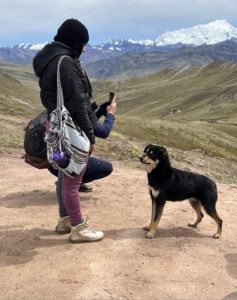
Village dog in the Peruvian Andes

Michael Baugh CDBC CPDT-KSA

Here’s what I’ve learned observing dogs in more than 20 countries around the world. The first is that dogs always live with or near people. This is not a species that lives independently among its own kind. While dogs may kill the occasional vermin, they do not hunt in organized packs. They eat our food, so-called human food. Dogs scavenge and negotiate food from us (i.e beg). They depend on us more than they depend on each other. They are inextricably attached to our world, connected to people. Wherever you find humans (and really, we live everywhere) you will find dogs. No humans, no dogs.

Here’s what else I have learned. Despite the universal similarity of being cohabitants with humans, dogs live very differently in other parts of the world. Of the 900 million dogs worldwide, eighty percent are free roaming Only twenty percent of all dogs have homes with human beings. North American Dogs’ lives are anomalous. They live in our homes, on leashes, vetted, crated, dog park bound, burdened with our emotional baggage, handled and touched at every corner and in every boutique dog shoppe and every daycare franchise on the continent. This is without a doubt unusual. It is not how most dogs on the planet live.

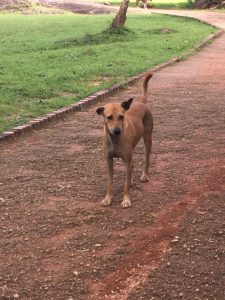
Roaming temple dog in northern Sri Lanka.

I’ve learned a lot about dogs just watching them. Here are some of my field notes in no particular order.

Dogs Roam. In Asia, Central America, and South America especially, dogs work the streets. Even dogs who have homes and wear collars with tags spend their days wandering off-leash.

Dogs seek food from us. This is true on each of the five continents I’ve visited so far. Dogs are food-seekers. They are not after ribbons or praise or attention or even our touch. They spend their waking hours working for food. Mostly they scavenge our garbage. Often they experiment with behavior so that humans give them food from their pockets, or their backpacks, or their plates – human food (no one in Sri Lanka is carrying a bag of Zukes dog treats).

Pulling at the heart strings of a hotel guest in central Sri Lanka

They’ve evolved to affect our emotions. This was one of the coolest realizations for me. Even the scrappiest dogs on the dustiest streets have “the look.” Dogs retain a juvenile looking face into adulthood, more-so than other species. And, everywhere I’ve encountered dogs they’d all adopted facial expressions that accentuate their puppy features, endearing, cute. When we see it many of us will get a rush of hormones, the same warm feeling that bonds us to our own dogs. I don’t want to ruin this romantic notion. But, at the same time, I will tell  you this face most often shows up when dogs are seeking food from us. I once ate at an outdoor restaurant in rural Costa Rica and four dogs where sitting politely about six feet from our table, each of them giving us “the look.” When we broke eye contact and continued our meal, they moved on to the next table, a respectable distance away, to try their elegantly evolved behavior on some other patrons. I will add, these dogs looked very well-fed.

They play with each other. This is less common in mature dogs. I saw it frequently with puppies and young adults.

They rarely fight. It’s usually over food and it is infrequent and usually non injurious.

Dogs use a lot of space when communicating. It’s quite rare to see dogs end up in tight spots together. They social distance. Very often I’ve seen dogs communicating with body language and facial expressions at 30 feet or more. It often appears to be about one dog asking the other may I pass or are you safe. Very frequently it looks like I see you, dude, come on through. Occasionally it’s about one dog denying access to a particular area. I remember a food court on a bluff outside a tourist spot in Colombia. Four dogs lived there. A brown short-haired  female dog about 50 pounds started to wander up the path to the parking lot and food stalls. One of the four dogs in residence, a large male, stood tall and stiff and gave her a hard look. She stopped and then hedged her bet, taking a step forward. That’s when big male bolted down the path towards her full speed. The once optimistic female tucked her tail and ran. They never got closer than 15 feet from each other. No one got hurt.

Dogs walk faster than us. We really need to pick up the pace to match their stride. Also, I’ve never seen a dog on the streets anywhere in the world run for any significant amount of time.

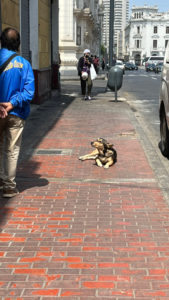
Sunning herself on the sidewalk in Lima, Peru.

Dogs are not naturally inclined to accept our approach and touch. Many will approach humans. Those individual dogs will often hang out for a little petting. A puppy outside a temple in Thailand stayed long enough to play with me (I had the sharp little tooth marks to show for it). But, generally speaking, dogs don’t want us reaching for them and folks elsewhere in the world don’t assume the right to touch every dog they see. Most dogs will keep a few feet between themselves and passing humans. As a result, I’ve never seen a dog behave aggressively towards a human in any other country. I’m not saying it doesn’t happen. But, I suspect it is not as common as it is here.

They stop at intersections without assistance from people. I’ve seen some stop when the cross walk signal is red and then go when it turns green, though this probably has more to do with learning to follow the mass of people than the signal itself.

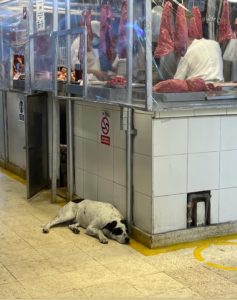
Napping in the market, Lima.

Dogs sleep a lot. Some sleep as much as 14 hours a day.

There aren’t many old street dogs. I don’t want to sugar coat the experience of dogs in other parts of the world. Do they seem happy? Yeah, I think so. And I also think dogs on the streets have hard lives. It’s a young dog’s game, street life. I have only seen one that looked older than maybe 5 or 6-years old. There was a 10 year old dog at the food court I mentioned above, but he belonged to a family there.

People love dogs. Just like you and me, people around the world love dogs. Many dogs have homes and warm beds, even ones who roam the streets all day. Letting the dogs wander freely appears to be how their humans express love (I do not recommend we do that here). People have small dogs they carry in backpacks or in the baskets of their scooters. Others have large dogs. Most dogs are a natural mix of genes, some are specific breeds. The range is similar to what we see here. People around the world laugh at their dogs’ silly antics. Also like you and me, they sometimes get frustrated calling their dog in at the end of the day (I saw a puppy in Peru who seemed to insist he needed just a bit more time romping with a friend on the cobble stone streets of Cuzco.) People worry after their dogs, keep photos of them, and mourn them when they are gone.

People and dogs. We’ve been together for as long as there has been history and probably longer. We’ve co-evolved. We are interconnected. Dogs as a species, most certainly, would not go on without us. They’d evolve into something else or disappear. Humans as a species would likely survive without dogs. But, it wouldn’t be the same. People around the world know that, too. It wouldn’t be the same at all.

Michael Baugh teaches dog behavior in Houston TX. He specializes in aggressive dog training.

What is my Dog Thinking?

Michael Baugh CDBC CPDT-KSA

What is my dog thinking? The truth is none of us knows. Period. I don’t even know what my fellow humans are thinking most of the time. And seriously, how many times have we all said to ourselves, what was I thinking? Even on good days it’s really hard to crack the code of homo sapiens, and we share written and spoken languages. The chances of ever knowing what a dog is thinking are zero.

Here’s where it gets tricky. We think we know. Clients tell me all the time they know what their dogs are thinking. Why? Because we humans hate an incomplete story. We hook on to one or two bits of information, usually a causal observation of what our dog is doing, and we fill in all the gaps. We create the story of what our dog is thinking. And, because the story was born of our own incomplete experience and the experience of our own complete thoughts, we perceive it as fact. Our brain believes, sometimes rigidly, what it knowns – even, in fact, when it does not.

Psychologists Daniel Kahneman and Amos Tversky called this natural human process “fast thinking.” It’s how we all quickly piece together information for decision making. The process is evolutionarily adaptive when it comes to safety and survival. Movement – dinner – aim -shoot. See a person – enemy – hide – fight. It even works well for us in modern times, in traffic for instance. Speeder – unsafe – avoid. We need to be able to create quick narratives for decision making with limited fast-moving information. Compare this to “slow thinking” which literally involves our slowing down, assessing all the information we have and that we don’t have, and making a logical conclusion. We do have that ability. Trouble is we don’t always take the time to use it.

Kahneman and Tversky coined the term behavioral economics (you might have heard of that). After Tversky’s death, Kahneman won the Nobel Prize in economics. What they discovered, in short, was that “fast thinking,” though useful sometimes, often leads us to make mistakes. The answer to the question what was I thinking becomes I don’t know but it was fast and it was wrong. Here’s a harmless example from my own life. Buzzing insect – wasp! – flail hands and run. It was a June Bug.  “Fast thinking” because of it’s early roots in survival is almost always hooked to emotion (Think: fear, desire, exhilaration). Fast thinking over time develops biases – the quick decisions we habitually make (unconsciously) about our fellow humans based on how they look. It’s also why we are notorious for making decisions with apparent pay-offs in the moment even though the long-term effects are disastrous (e.g. buying the hot sports cars instead of saving for retirement). Politicians and marketers know how hack our “fast thinking” and exploit our biases and desires. Believe it or not, some dog trainers do too.

What is your dog thinking? Disreputable trainers will tell you. It will come with just a few facts (he’s growling and showing his teeth). Then they will fill in all the gaps to form a concise memorable story that our “fast thinking” brain will love. He thinks he’s dominant, or He doesn’t respect you or He’s trying to be pack leader.  Add to this that we might have already heard that story from our neighbor or our Uncle Charlie.  Our fast thinking brain shores up the narrative with more non-facts. That’s called confirmation bias. It becomes fact to us because it came from our own brain and was then echoed by others. Trouble is, we still have no idea what our dog is thinking. And what does dominant dog really mean (the definitions are as varied as they are vague. And, do dogs actually form pack hierarchies (the evidence suggests they do not)? And yet, it’s hard to let go of short, simple, fast thinking explanations to the point that we might actually push back when presented with real verifiable facts. Psychologists call that cognitive dissonance. Welcome to the most advanced brain on the planet.

We aren’t doomed, however. At least I don’t think so. We all have the ability to slow down, check and recheck our observations, assess facts, look at alternative explanations. When it comes to our dogs I suggest this. Focus on what your dog is doing more than what you think he is thinking. Disconnect from the story; connect to the present moment with your dog. You are communicating. Your actions (behavior) influence his actions (behavior) and back the other way. People often ask who’s training whom. My answer is you and he are both teaching and learning. Enjoy this moment, this time to set aside troubling thoughts, this time to simply explore and learn with your dog. It may not be the story you thought it was. But, it is more profound than most prose and as inspiring as any poem.

Michael Baugh teaches dog training in Houston TX. He specializes in aggressive dog training.