
Getting Jumped

Michael Baugh CPDT-KA, CDBC

We teach our dogs to jump on us. I hope that comes as no surprise. Watch how we interact with dogs, especially puppies. They run to new people with boundless excitement and jump up to greet them. We love it, right? Puppies are small and adorable. We bend down to pet them, chat them up with a little baby talk and sometimes even pick them up so they can kiss our faces. Puppies learn from almost day-one that the best way to get the ultimate human interactive experience is to, you guessed it, jump on them.
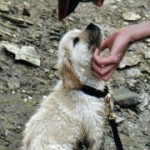
Apollo at 11 weeks (sitting politely)

It hardly seems fair that about 5 months into the process we decide to change the rules on them. But of course that’s exactly what we do. Adolescent puppies can be big and awkward. We may not have learned to trim their nails yet, so those are sharp enough to hurt us. Our puppy still runs with that boundless energy but he’s faster and stronger. Now that cute puppy just seems rude to us. But watch what people do even with older puppies. The dog jumps. We still pet. I’ve seen it hundreds of times. Even if we don’t like the dog’s jumping we still seem compelled to reward it with petting.

Stop. If we’re going to change the rules on our adolescent dog let’s at least be clear about it. No more petting for jumping. Let’s decide from now on the dog now gets nothing at all if there’s an accidental jumping episode: no touching, no talking, no nothin’. And be careful. There’s a trap here. Even punishment counts as interaction. Yelling at your dog for jumping or grabbing his paws or kneeing his chest are all reactions to his jumping (the latter can cause serious injury). Your dog is jumping to seek attention and sure enough you’re giving it to him. Stop.

Read on because this is only one part of the plan. And it’s the hardest part. Cutting off reinforcement for bad behavior (above) is not the same as ignoring bad behavior. Please remember that. We’re actually paying very close attention to solving this problem. Admittedly, it is very hard to let a dog figure out on his own that jumping doesn’t work. As a trainer I have no problem putting on my jeans and an old t-shirt and letting a 6-month old Golden Retriever jump on my until she figures out I’m not responding to that behavior (it usually takes less than 5 minutes). But I also know you may not have the patience for it. Turning your back on the dog helps. Leaving the room helps. Patiently waiting with your arms folded and your gaze averted to the ceiling helps. You’ve heard all these solutions but they are only part of the plan.

We’ve taught our dogs how to greet us the wrong way. Certainly we can teach them the right way. I love few things more than the sight of an energetic dog running towards a person full speed and then sliding into a sit. I guarantee you every basic obedience class in town teaches this (it’s called a recall – but most of us call it “coming when called”). The preferred method of teaching recall with a sit involves treating the behavior. That’s because behavior followed by positive reinforcement gets stronger (remember how much petting made your dog jump more?). So, treat and praise to your heart’s content. You dog will get really good at coming when called and sitting.

We’ve left a bit of room for error here and I want to tidy that up. A lot of dogs will sit for us, get a treat or a pet and then jump on us. I guess jumping must feel really good. Or maybe they can’t contain themselves. No matter, there is the simple solution of behavior management here. Let your dog drag his leash around the house (I prefer a simple 6 foot leash). Make sure you only do this when you can supervise him. Definitely do it when guests are coming over. Now imagine that cute 6 month old Golden Retriever bolting up for you and sitting nicely. While you praise, pet or treat her, deftly step on that leash at the same time. If you hit the leash somewhere in the middle she won’t have much room to jump up on you even if she tries. The leash will stop her a few inches into that jump. It’s even easier to do with a visitor since you’ll have the leash in hand to start. Letting your guest greet the dog while you step on the leash gives your dog a chance to learn how to do it right. Of course dogs who are shuttled away to a crate or taken on a walk when guests come over do not suffer. But they also don’t learn how to greet properly either.

Okay, let’s review this stuff.
1. Stop reinforcing jumping: no petting, talking or even reacting in a punishing way. Turning your back or passively waiting for the jumping behavior to extinguish can work but it takes heroic patience. (See step 3).
2. Teach the right way for your dog to greet: always come when called and sit for pets, praise and treats (there are tons of reward-based trainers in town who teach this).
3. Finally, management: block jumping behavior by stepping on the leash. This helps prevent your dog from successfully practicing jumping on people.

I can already hear some keyboards clicking away with a response to this blog. Yes, I know you or you neighbor or your Uncle Ralph slapped a choke collar on and solved the jumping problem faster than lightning by whipping the dog into shape. Cool. I don’t teach that method for a number of reasons. But debating force-based training versus reward-based is not really what this blog is about.

That said, I invite you all to share your experiences. Better yet, post a picture of you and your dog. Few things in life are as nice as a picture of a person and a dog in happy times. They’re not with us that long. So, live it up.

Calming Shelter Dogs

Michael Baugh, CPDT-KA, CDBC

Sometimes the best thing you can do for a shelter dog’s emotional well being is nothing at all. But, please don’t misunderstand. “Nothing” in this case doesn’t mean neglect. If fact, this kind of “doing nothing” takes a great deal of attention and patience.

Dogs in shelters live under a great deal of stress and constant stimulation. People are coming and going. The lights are on for long hours. Dogs are barking and jumping and pacing. It’s a heartbreaking cacophony to those of us who work and volunteer in shelters. For the dogs it’s nightmarish. And it leads to progressive behavioral deterioration.

It’s no wonder so many of these dogs are frenetic when we take them out of their runs. They jump on us with apparent glee. They wiggle and wag and pant. Their excitement is over-the-top. We’ve all seen this before. They are filled with joy to be out of there and interacting with us. That much is true. The trouble is they are so aroused by their environment that they have no idea how to control themselves around people. They look crazy. It’s no wonder. They live crazy lives.

Because we care and because we love them, many of us reflect their joy and excitement right back at them. We pet them; tussle their ears and talk our sweetest most energetic baby talk. Then we trot them out for potty time and exercise. There’s no real harm in that. We’re only human after all. But are we doing any good? Is this dog learning how to live in a home with a family? Or is he just learning to freak out and jump with exuberance on every new person he meets?

I know. Those are hard questions to ask ourselves.

Let’s try this instead and see how it works. Behave the way you want the dog to behave. It turns out that dogs are very good at reading our body language, facial expressions and overall emotional tone. Be calm and project that calm onto the dog. Take him out of his run quietly, with a gentle hello. Walk outside at a normal pace. It’s okay if he’s jumping and pulling. This is new and he’s been living the bad version of la vida loca. Patience. Once he’s gone potty find a nice place to sit and quietly give him focused attention. Exercise is a good thing, but shelter dogs need quiet “down time” more than anything. And if it’s with a human being (you) all the better. Just sit quietly and observe. Breathe. Loosen your shoulders. Wait for the dog to calm with you. This may take a while. Say nothing.

If the dog looks at you, smile and in a gentle cooing voice say “good.” When you pet him, do so gently and slowly. You’ll find it’s very easy to accidentally get him wound up again. That’s okay. Start over. Once he starts to calm again, whisper “good boy” or “very nice.” The words are less important than the sound of them, soft and relaxing. Imagine the dog laying down at your feet, drifting into the first relaxing moment he’s had all week. Pet with long gentle strokes, no scratching or tussling. Good. Treats for eye contact, sitting or laying down are fine. But you might notice food is arousing to the dog as well.

This calming technique is great for dogs in foster care or ones freshly adopted from shelters. It’s a perfect way to just chill out with a dog who’s otherwise been wound up all day. I do it with my own dog. And I recommend it for every dog you visit at the shelter. If you’re lucky enough to interact with the same dog more than once, see if you notice a change in his reaction to you. Most adopting families want a dog who can settle down and do nothing with them. And sure enough, that’s exactly what you’re teaching your shelter dogs. Do nothing. And enjoy.

Raising Stella – The Potty Problem

Michael Baugh, CPDT-KA, CDBC
I used to say “potty training is easy.” What I really should say now is “potty training is not complicated.” That’s the first lesson I’ve learned from Stella (I’m sure there will be many). Potty training is not easy. It takes a great deal of work and attention. However, the idea of it is pretty darn simple.

Stella at 4 1/2 months

Stella only has two states of existence right now: 1) safely confined and 2) interacting with a person (supervised). The confinement part is pretty easy. Stella actually seems to enjoy her quiet time in the crate. Some dogs fight this tooth and nail (some literally breaking teeth and nails). But Stella is cool with it. Of course, we can’t keep her in there all the time. So, the rest of the time she’s interacting with people under close supervision. And that takes a lot of work. In the first three hours of this morning Stella and I have been out for two potty breaks (more on those below), some play time, a potty break for me (yup she came with me), coffee and breakfast in the kitchen together (she ate too), and then some writing up in the office. She’s lying on her bed next to me, her leash attached to my desk, while she chews on a bone. I have not had a single waking moment without her by my side. I’m not complaining. But it is work.

That’s half of potty training – setting Stella up to win, making sure she doesn’t have the chance to poop or pee in the house. And after one week I can happily report that it’s working. Yes, there was one incident mid week when we had a lot of rain and she didn’t want to get her “princess fur” wet. Instead she got my kitchen floor wet. But we won’t focus on the negative. Her success to failure ratio is still phenomenal.

The other half of potty training is showing her that outside is the place to do it. And I mean the place. It’s simple but not always easy. In theory all you have to do is reinforce the puppy for going in the right spot. I recommend cheering, praising and then giving three treats one after the other as soon as the deed is done (immediately, don’t wait until you bring the puppy inside). Simple right?

But easy? Well, I found out pretty early on that Stella is not too keen on food when she’s outside. Some days she just outright refuses it. So I quickly had to remember the science of behavior. The training is not about the “treat.” It’s about whether or not the behavior changes. Clearly if Stella refuses food, then giving her a treat for going potty is not reinforcement. I needed something that would increase her “peeing outside” behavior and it wasn’t going to be food. Play. That’s a good one. Stella likes romping around and playing. Petting. That works for Stella too. So right after she goes I praise her enthusiastically, run around in circles getting her to play and I scritch (that’s a technical term) her chest. I look like a fool. But while the neighbors laugh I have a clean house.

On one of those rainy nights I knew all Stella wanted was to get back inside to dry her “princess fur.” Begrudgingly, she popped a squat and did her thing. In that brief moment I thought of the biggest jackpot prize I could come up with to reinforce her good behavior. It sure as heck wasn’t going to be a piece of kibble. It had to be bigger, something she could really use. So, as soon as her deed was done I laid it on her. “Good girl Stella, let’s go inside!” I was her hero. Smart girl. Smarter daddy.