In Tad We Trust

Michael Baugh CPDT-KA, CDBC

I get to see Tad again tomorrow, and the anticipation has had me thinking about the brilliant truth of teaching and learning.

Given the right set of circumstances, a learner will tend toward making the right decision.  Scientifically that means if we set up the environment correctly our student will succeed.  That includes both environmental cues and pleasant consequences for the learner.  So much for the nerdy part.  Here’s the softer part.  All of my students really are working toward success; it’s the natural tendency of progress.

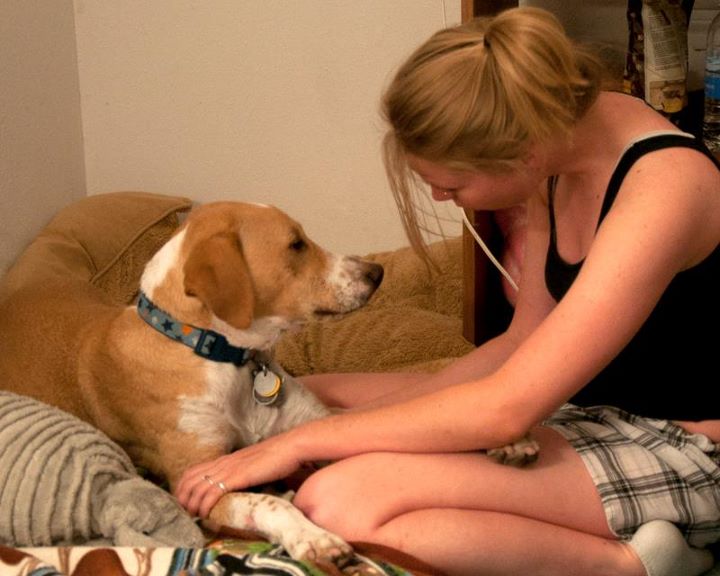
A perfect learning relationship

There isn’t anything inside Tad that predestines him to behave poorly.  There’s no internal badness in dogs that we humans have to break or dominate.  Dogs, like all other learners are naturally (meaning it’s in their nature) built to discover the easiest right choices for behavior, and to act on them.  In fact, even “bad” behavior is at the time the perceived right choice for the dog.  Our job as teachers is simply to clear the path, make the choices we prefer more obvious, and reinforce those correct choices joyfully.  That’s teaching.

I always trust my client dogs to find and make the right choice.  If they don’t, I look at myself first to make adjustments.  I never look inside the dog for sinister intentions with flimsy labels like stubbornness or jealousy.  What can I change in this student’s environment to make it easier for him to make a correct behavior choice?  When he makes that correct choice, how can I tell him he got it right so that he makes that choice again in the future?  I joke that dog teaching isn’t a religion it’s a science.  Still, it takes a whole lot of faith to ask those questions, trust the dog, and trust the process.

I smile every time I remember that humans can be trusted too.  When we talk about a learner’s environment, we’re really talking about relationships.  A supportive, empathetic relationship between a teacher and a learner (and really we’re all co-learners) sets the client up to succeed, every time, without exception.  I nod respectfully to the late Carl Rogers who brought this knowledge to us.  Humans are naturally built (meaning it’s in their nature) to ascend to the highest level of success possible, given the right environment and relationships.  Abraham Maslow called that “self actualization,” and all of us are on the path.  My path as a teacher and a learner fills me with faith every day.  I trust the people I teach, and the dogs they teach in turn.  I learn from them too.  Certainly, it’s not always easy.  Tiffany will tell you that, as will Tad in his own way.  Still, we travel on together, clearing the path for our better selves, applying the science with abiding faith.

Something to Chew On

Michael Baugh CPDT-KA, CDBC

Dogs chew.  It’s not just a puppy thing either.  Dogs actually chew throughout their lifetime.  It helps pass the time, keep their teeth clean and diffuse stress.  More than that, it appears to be fun and satisfying for most dogs.

A lot of folks ask, “How do I get my dog to stop chewing?”  We should probably ask a different question.  Perhaps, “can I teach my dog to chew something else other than my stuff?”  Now we’re on to something.  The idea is to teach your dog to chew this and not that.  Here’s a straightforward two-step process.

Step one:  limit choices.  Make it more difficult, if not impossible, for our dog to make the wrong choice.  If your dog is chewing furniture, keep him away from his target.  If he’s tearing up clothes, make sure all the clothes are out of reach.  Woodwork?  Safely confine and carefully supervise your dog.  Some trainers call this management.  I call it good common sense.  Don’t set your dog up to lose time and time again.  The truth is your dog doesn’t live by a moral compass.  There is no right or wrong; there is only available or non-available.  Make the wrong choices hard to find.

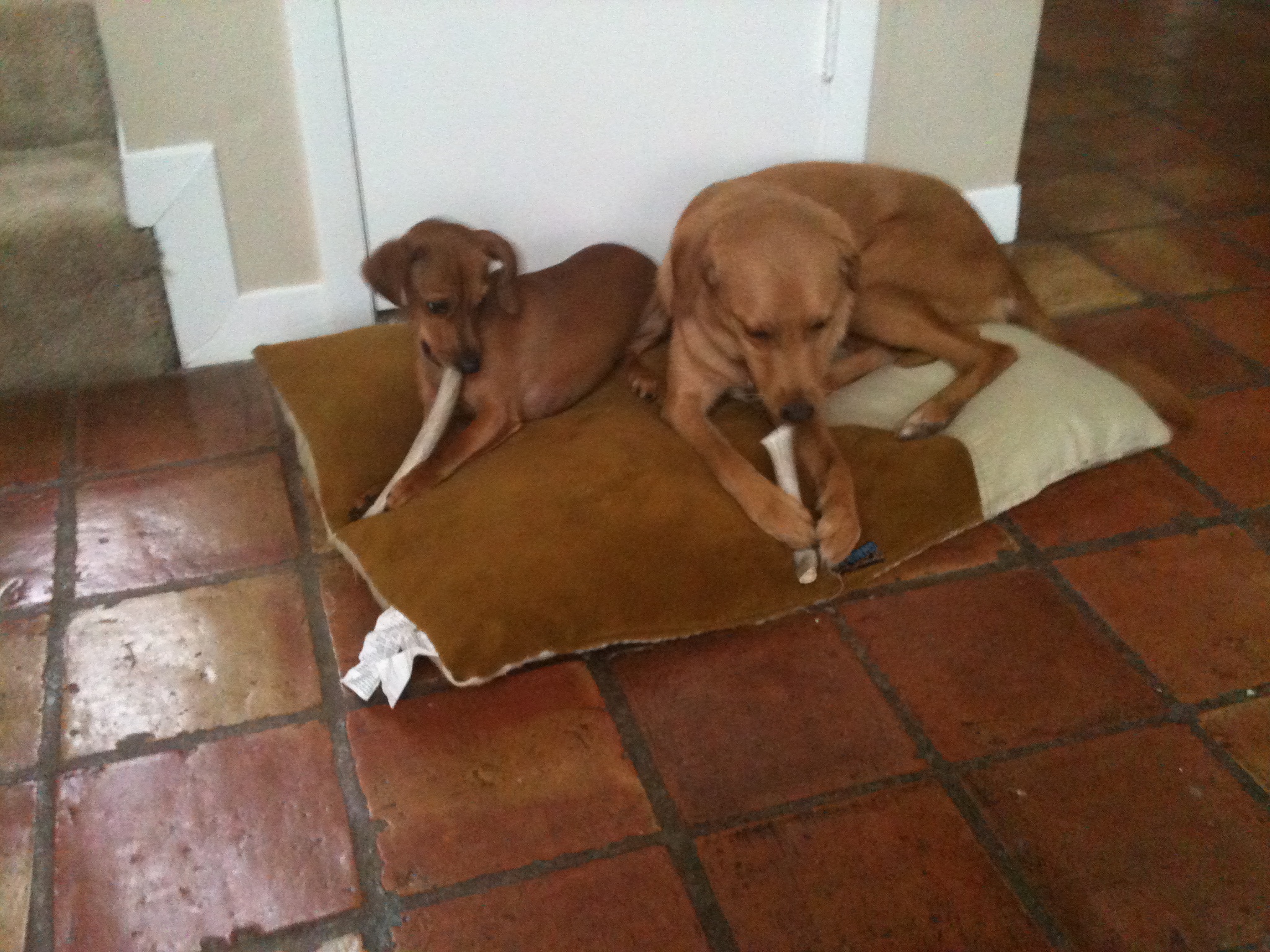
Stewie and Stella enjoying elk antlers

Step two: make it easy to make right choices.  Give your dog chewing options which are both allowed and better than the other options (like furniture).  I’m a huge fan of fully packed Kong Toys.  Don’t just smear peanut butter in there with a measly treat.  Load that bad boy up with a meal.  Then revel in watching your dog solve the puzzle of unpacking it.  Of course, there are tons of other chewing options.  My dogs love elk antlers.  Stella, in particular, really enjoys cardboard paper towel rolls.  Of course, I give these to her and we always supervise chewing.  Avoid putting out too many choices for chewing.  Remember, we want to make the choices easy.  A room full of toys and chew sticks doesn’t make for easy choosing.  Everything looks like a chew toy in that setting, and then we’re back to square one.

Changing your dog’s behavior is all about making smart changes in the environment.  Left to their own devices dogs will do the best they can, but they won’t always make the right choices.  With just a little help from us, they can win every time.  Make it harder for them to chew on the stuff we don’t want them to chew on.  Make it easy and rewarding to chew on the right stuff.  Keep that up for a few months and watch what happens.  You’ll be so happy watching your dog chew up something you gave him that you’ll wonder why you ever wanted to make him stop.

Originally published on the Houston Pet Talk blog.

Changing Your Dog’s Behavior

Michael Baugh CPDT-KA, CDBC

Changing behavior is all about verbs, actions.  We can observe behavior in real space and time because it is physical and often includes movement.  We describe behavior with verbs.  He sits.  She runs.  They eat.  Remembering that helps us steer away from the labels we put on dogs, like dominant, dumb and stubborn.  Those are adjectives, and the only real way to change them is to stop using them.  Actions, on the other hand, we can change.

I didn’t invent the science of behavior change (I wish I had).  In fact, there isn’t a dog trainer in Houston or anywhere else for that matter who can make such a claim.  The truth is, the core concepts of animal training (including the human animal) are more than a century old.   And they are among the most tested and verified bits of knowledge in the field of psychology.  That’s a good thing really.  We dog trainers don’t have to reinvent the process.  Be careful of those who claim to.  I wrote about the science of dog training in the March 2011 issue of Houston PetTalk.  While we are always refining the way we apply the science of behavior change in dogs, the fundamentals remain the same.

Ah science.  There seems to be a collective yawn when the topic comes up.  Maybe our concept of science reminds us of boring afternoons in the classroom.  That’s not what I’m talking about here.  Using behavior science in dog training is cool, very cool.  In fact, every trick you have ever taught your dog is an example of applied behavior science.  Dolphin shows are excellent examples of it.  Behavior science is actually happening all around us.  Dog trainers use it all the time in some form or other, even if they don’t fully understand it.

Photo Courtesy: Robyn Arouty

Here’s how it breaks down.  A behavior is repeated (and becomes habit) when there’s a history of favorable consequences following the action.  How about an example?  Put on a sweater – enjoy warmth and avoid being cold.  Nice!  Here’s a doggie example.  Knock over the garbage can – enjoy snacking on the spilled food scraps.  The actions of putting on a sweater and raiding garbage cans will increase over time because of the consequences.  Changes in the environment set these learned behaviors into action.  Let’s look at the human example again.  The temperature drops when the sun goes down – put on a sweater – avoid the cold.  The temperature drop didn’t cause the action of putting on a sweater, but it did set the stage.  Perhaps the sight of a garbage can and the absence of people set the stage for the action of knocking the can over.  In both examples, it’s the consequence which keeps these actions going time and time again.

You’re on your way to understanding how to change behavior (your dogs’ actions).  Cues from the environment (we are part of our dogs’ environment, by the way) and consequences in the environment influence our dogs’ actions.  That’s very good news for those of us who live with dogs.  Why?  Because we can change their environment.  We can remove garbage cans as a potential trigger of destructive behavior.  We can also provide food-delivery toys like Kongs and Bob-a-Lots for better behavior when the dog is left alone.  Now we have the tools we need to change behavior.  We actually had them all along.

Think of anything your dog does that you’d like to change.  Remember to use verbs.  Then think of what happens right before the action, and right after.  Those are the trigger and the consequence.  Can you change either of those, or maybe both of them?   When a visitor comes to the house (trigger), and your dog jumps on her (action), does she pet him (consequence)?  How many of those environmental pieces can you influence?  Better yet, could you teach your dog that when the visitor comes (trigger), he sits politely (action), and she gives him a snack and some petting (consequence)?  I bet you could.

The best part is we’re focusing on our dog’s actions and things in the world around him we can control.  We’re not worried at all about labels.  Those are adjectives and they are not of use in changing behavior.  We’re all about verbs (like sit, and come, and look at me).  And we’re not just looking at our dog’s actions either.  The best way to change an animal’s behavior is to make a few little changes to the environment, and this often means changing our own behavior.

Now we’re talking about a wonderful noun:  Relationship.

(originally published on the Houston Pet Talk blog site)