
Positive Thinking – Positive Training

Michael Baugh CDBC

You know the look they give us. They cock their head and flash those weary eyes. It’s as if they are saying, “For God’s sake, human, what are you thinking?” It’s the way our dog, Stewie, looks at us just about every day.

If you ask me, our dogs are on to the right question. What we think and how we perceive our world has a huge impact on how we feel and how we humans behave day in and day out. Psychiatrist Aaron Beck writes about cognition and its impact on depression, relationship problems and other psychosocial maladies. For Beck and other cognitive behavior therapists, the trick to feeling and living better begins with changing the way we think. Hmm, makes sense.

So, let’s think about our dogs for a minute. Better yet, let’s think about how we think about our dogs. Take a moment just to let some random thoughts run through your head. Cognitive therapists call these “automatic thoughts.” They’re the things we think about without really thinking. As a trainer, I get to hear a bunch of people’s automatic thoughts about their dogs. Most of them aren’t too upbeat. “He’s stubborn.” “She’s too distracted by other dogs.” “He’s aggressive.” “She’s shy.” “He won’t do that.” “She doesn’t like treats.” And then there’s my all-time favorite, “My dog is being dominant.” Add to the list if you’d like. We could fill the page.

Negative thinking is like poison. This is true in dog training. Our thoughts and beliefs serve as filters for all that we observe and experience. They directly and immediately influence our feelings and actions. Here’s an example. Our dog jumps on a visitor. We may think our dog is “bad,” or maybe “overly friendly.” That can leave us feeling hopeless or even angry. The result may be that we give up on trying to help our dog change his behavior (mistakenly believing that training is a lost cause). Or, worse yet, our anger may lead us to harsh or abusive training methods.

Now let’s look at the same scenario again. The only thing we will change this time is how we think about the situation. Our dog still jumps on the visitor, but instead of thinking poorly (and inaccurately) about him, we notice the dog is behaving the same way many dogs do. We may feel some comfort knowing that behavior can change (if my dog learned to jump on people, he can also learn other things). There are no feelings of hopelessness or anger. We can take calm, rational action. We can teach our dog some new skills.

Dog training really starts in our head. Yes, it involves timing, eye-hand coordination, knowledge and skill. But you can throw all that stuff out the window if you’re not in the right frame of mind. It’s time to weed out some of that negative thinking.

Step One: Be aware of your own negative thoughts. Some of them are just plain obvious. If you’re mumbling “stupid dog,” then you can chalk that up as a negative thought. But others might be subtler. Here’s my favorite way to identify a negative thought in dog training. Ask yourself, “Does this belief or way of thinking help me train my dog, or does it just upset me and leave me confused?” If it’s the latter, then discard the thought. It’s negative and therefore useless to you.

Step Two: Think happy thoughts. It worked for Tinker Bell and Peter Pan. No, I’m not kidding! Think happy thoughts and imagine where you can go with your dog. I suggest you start by speaking well of your dog. When you get a chance, tell someone how smart your dog is or what a fast learner she is. Then take it a step further by telling your dog how wonderful you think she is. Maybe she’ll understand you. Maybe she won’t. But by verbalizing positive thinking, you will automatically think more productively about your dog and training.

Step Three: Visualize. You already do this every day. You might map out directions in your mind before you get behind the wheel of your car. Golfers imagine sinking a putt before they actually hit the ball. We say things in our head before we speak them aloud. So why not visualize training your dog? Picture a nice crisp sit. See your dog heeling beside you. Imagine her greeting a guest politely without jumping. If you’re seeing good behavior in your mind’s eye, then you are crowding out negative thinking. You’re already on your way to better results.

Step Four: Build on success. Make positive thinking a way of life, just as you have with positive training. The fewer negative beliefs there are getting in the way, the more you will succeed. The more you succeed, the more confident your thinking will become. You can see how this quickly snowballs into ultimate success.

None of us got a dog so that we could think poorly of him. None of us wants a ho-hum relationship with our dog. And certainly none of us wants to fail at training our dogs. So, by all means, let’s get rid of anything that gets in the way of what you really want—a powerful and satisfying bond with the animal you love.

Think well. Feel good. Act it out.

Michael Baugh teaches dog training in Houston, TX. He specializes in dogs with aggressive and fearful behavior.

Puppy Adolescence

Michael Baugh CDBC

They grow up so fast.  But honestly, some puppies just can’t grow up fast enough.  They go from cute to incorrigible in no time.  Then they seem to get stuck, for months, or for years.

We call it puppy adolescence, probably because it so horrifically mirrors human adolescence.  Our dear sweet puppies who followed us around and learned their manners so quickly, suddenly go wild.  A dear client of mine said she hardly recognized her own dog when he suddenly went rogue at the pet  store.  Atticus was a 5-month-old Rhodesian Ridgeback, and a model puppy.  Then in aisle 7 he met a boxer who he absolutely had to play with, right there, right away.  Atticus learned in that very moment that he’d grown in size and strength.  He pulled hard on his leash to reach the other dog (who was barking and growling, by the way) and gave my client’s shoulder a good hard strain.

Welcome to the next year of your life with an adolescent puppy.

The early months of puppy development are all about teaching him that the world is a safe place.  Before they come into our lives, puppies learn to interact with siblings and their mother.  We hope they also have healthy interactions with humans in their birth homes (dogs born on the streets and in puppy mills aren’t so lucky).  Once they come to us, we introduce them to the various types of people and human activities they will encounter throughout their adult lives.  The goal here is to show them that those crazy humans and their weird ways are really quite safe and great fun for puppies.  We coo, praise, and offer lots of tasty treats.

By 4 ½ to 5 months, our best efforts have produced calm and confident young dogs.  We’ve been to puppy class for some beginner manners.  Potty training and puppy biting are both under control.  Now we have a developing dog who is growing in size and intelligence.  They’ve had a taste of the exciting world, and they are hungry for more.

Atticus already weighs 45 lbs.  He’s strong, and he’s sharp.  He’s also is a savvy learner.  That’s good news because Atticus has an excellent early history figuring out how to respond appropriately to humans, especially his human family.  That can be a double-edged sword though, because Atticus is also quick to learn what to do to get his way in general.  For example, jumping up on counter tops gets him free snacks (sometimes).  And, pulling toward that boxer in the cat toy aisle gets him closer to an impromptu play date.  Our adolescent dogs discover that behavior pays.  Good behavior or bad, those are our labels.  It’s all the same to our dogs.  Whatever behavior works is good for them.

Helping your dog through adolescence is similar to getting him through early puppyhood.  It’s all about structure, and setting your dog up to succeed.  But the specifics are a bit different.

  1. Focus on what you want your dog to do, not what you don’t want him to do.  Teach him skills and practice daily. For puppy people who have already been training, much of this will be review.  Start thinking about basic manners as solutions to problem behaviors.  Sit prevents jumping on people.  Down teaches your dog to relax and slow down hyperactivity. Coming when called averts many varieties of mischief away from you.  Eye contact while on-leash prevents pulling and lunging.  Reinforce the behavior you want and you will get more of it.
  2. Teach impulse control.  Stay, leave it, and drop it are all good starts.  Just remember point one: focus on what you want your dog to do.  Impulse control isn’t about your yelling “no.”  Stay means your dog holds his position and focus on you.  Reinforce this activity.  Leave it means your dog takes is eyes off of trouble and looks at you instead.  Clicker training is a great way to teach him to do that reliably when you call “leave it.”  Drop it is also an activity.  Release the object in your mouth.  Yes!  Good dog!
  3. Turn play into learning.  Our adolescent dogs are eager for activity and play.  Integrate playtime and training time.  You can reinforce all of the lessons above with tug, fetch, and other types of play.  Experiment and see what your dog wants to work for.  You can also use treats.

Exercise and a healthy diet are also very important.  You might want to ask your vet if your dog’s breed and overall physical development are appropriate for dog sports like beginner agility, fly ball, or dock diving.

Now, pause for a moment.  Imagine who you want your adolescent dog to become.    Think about walking your dog down the path toward that goal.  What will you teach him along the way?  How will you let him know when he’s getting it right – smiles, praise, clicker train, play?  Choose to let the bad stuff fall to the wayside.  You already know that punishing behavior gives it too much of your attention.  Watch your dog grow in size and strength, but also in spirit and maturity.  Imagine the noble old dog he will someday be.

You will make it through your puppy’s adolescence.  I bet you’ll even forget how hard it was.  If you’re like me, you’ll wish time had moved more slowly.  Darned if the little guy didn’t grow up too fast.

Michael Baugh teaches dog and puppy training in Sedona, AZ


The Nonsense of No

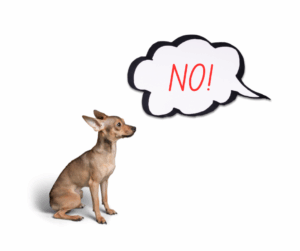
We all do it: fuss at our dogs, yell at them to stop doing this or that.  More often than not our rants begin with a sharp stern “NO!”  The funny thing is with most of our dogs the “no” results in nary a pause in the action, a look of glum recognition followed by more of whatever it is we wanted him to stop doing.   The sad truth is, “no” is a nonstarter.  It doesn’t work.   And yet we keep barking away.  “NO!”

The main problem with “no,” of course, is that it’s devoid of any instructive content.  What does “no” mean?   If a dog is jumping on our guest, for instance, and we yell “no” what are we communicating to the dog?  Maybe we’re letting him know we’re angry, but we’re not conveying even an inkling of what we want him to do.  Part of the reason is because “no” means so many things to us.  We yell it when the dog is jumping up, but also when he’s running away, digging, barking, and pulling on his leash.  It’s too vague.  It also violates one of the golden rules of dog training:  a command can only have one meaning, not many.  Inference, creating meaning out of context, clues, and the subtleties of language is a uniquely human quality (and not always one of our best).

Of course, we humans are clever.  So we add the offending behavior after the word “no” to help our dogs understand our indignation.  We say “no jump,” or “no bark.”  In my many years as a dog trainer, and the many more as a human being on this planet, I’ve never heard a dog use a verbal language.  The idea that our dog understands our particular meaning of the word “jump,” much less its antithesis, is a huge leap of logic (pun fully intended).  They are linear, not relational, thinkers.  Plus they follow visual cues better than words.  Never mind the minutiae of behavior science.  Yelling no-anything just makes us sound like cartoon cavemen.  It’s silly.

So what are we wordy creatures to do?  We just want our dogs to STOP IT (whatever it is).  Are we hopeless?  No.  Let’s try this instead.  What do we want our dogs to do?  When our dog is jumping, what would we prefer he was doing?  Sit, perhaps.  We can teach that.  “Sit”, when taught properly generally has one meaning (place bottom on ground).  Awesome!  I can teach my dog to sit, and if he jumps on a guest I have something clear and meaningful to yell at him.  “Sit!”  His bottom hits the ground – jumping ceases.  It might take some practice, sure, but the meaning is clear.  Do this, not that.

Some of us will still yell out “no” in anger (move me to the head of the mea culpa line).  That’s okay if we just remember this.  Follow up with a clear instruction.  If we see a dog digging a hole in the back yard, we might bark out “no” in our justified anger.  But then what?  Add meaningful instruction.  “Stella, come.”  Stella is my dog’s name and she has a pretty decent coming-when-called.  It’s liable to get her away from the hole, at least long enough for me to get her on to a new task.  “No” is quickly forgotten.  The instructive part was calling her to me.

Try this, too.  When your dog does something right, pick a word that means they’re getting a tasty bit of food.  The word should be short and crisp, timed exactly with the good deed to let them know a food reward is on the way.  That’ll get them learning.  Actions result in delicious consequences.  The word marks the moment of success.  Of course, I have a favorite word for this kind of teaching.  “Yes.”

Michael Baugh CDBC teaches dog training in Sedona, AZ.  He specializes in aggressive dog training.