Could AI Train my Dog?

Michael Baugh CDBC


Some dog training is robotic. In fact, I teach some techniques that way. Keep your hands relaxed and still. Cue a behavior. If the dog performs the behavior associated with the cue, mark the behavior with a click or a clear marker word. Then, reach into the treat bag and deliver a bit of food to the dog. The process is crisp and clear. Non-human artificial intelligence could pull it off.

Actually, AI would nail it. Dogs perceive cues from non-human sources all the time. AI can already perceive live video. Remote feeding devices have been around for decades. It’s a no-brainer, literally. (Well, our dog has a brain, but you get it).

With some work, artificial intelligence could actually train with environmental cues, like teaching a dog to station on a bed when a doorbell rings. That would be cool.

The only thing missing would be everything else.

Training with our dogs isn’t only about teaching a list of tasks. It’s about learning communication. Our dogs learn from us, our verbal phrases, our body language, and facial expressions. And we learn theirs. Faced with a new and potentially challenging situation, the discourse is easy. Our dogs and we navigate the situation on the fly. This is how our dog learns behavioral flexibility. It happens in real life, with us.

Artificial intelligence is excellent at learning patterns. It’s quick. It uses pattern recognition to infer outcomes. That’s amazing. And it’s getting better. AI can learn a great deal about us. It can learn about our dogs. Artificial intelligence will never be human, though. Never a dog, either.

I fell in love with my dogs while teaching them. It’s intoxicating, that flood of neurochemicals: oxytocin, dopamine, adrenaline. I don’t know them all. It’s a cocktail you can only make with a dog. A friend. Another living being.

The first time I ever taught a dog to stay, we looked lovingly at each other from across the room. My dog wanted to run to me. I wanted her to. But we both knew the game, so much fun, waiting. Artificial intelligence is helpful; I’m glad it’s here. But AI will never know what I felt teaching stay that day. It will never feel.

Humans and dogs evolved with each other. We grew up together over millennia. Our interactions are as sloppy and unpredictable as they are inspired. Yes, we communicate with clicks and treats. And we communicate with laughter, and play bows, and winks, and smiles, and stillness, and brief moments of silence. Yes!

Trainers sometimes tell students that dogs are forgiving of our messy, inconsistent training. I wonder if they thrive on it. This is who we are together: dogs and humans. Organic. Alive. Perfectly flawed.

I know it sounds diminutive, but AI has its place. Help my brain, my wobbly memory. Help me see the pattern here I don’t see. Maybe artificial intelligence will claim some big spaces. Heal our bodies. Enrich our lives. Open a world at our fingertips.

Things dogs do.

Tread carefully, my dear sensitive, loving fellow humans. Take my hand. Laugh with me. Tremble if you must. So much is unknown. Make room for this artificial invention of ours, but keep it out of your heart. Meet me out on the path instead. Walk with me, just a couple of people chatting.

And AI, our helpful illusionist. Respectfully. Stay away from my dog.

MIchael Baugh teaches dog training in Sedona, Arizona and Houston, Texas. He specializes in aggressive dog training

The Sedona School of Dog Training: Learning from Nature

Michael Baugh CDBC

In Sedona, Arizona, we keep the lights low at night. It’s a community decision, an ordinance: dim our light so we can better see the heavens. It is one of the beautiful ways people live here, a gift to ourselves and our non-human neighbors.

Fewer than ten thousand people live in Sedona. More than three million visit every year. We answer to the call of coyotes, to the dry, rusty sand and the afternoon monsoons, to the prickly pears and the soothing calm of towering sandstone. We come to find ourselves, only to find that we are part of something much bigger. The natural world, that which we cannot bend to our egos, welcomes us, teaches us flexibility of will, sharpness of mind, and softness of spirit. We learn to dim our own light so that we can better see.

Nature taught us positive reinforcement dog training. Living things seek safety, nourishment, opportunities to grow, and to reproduce. Their environment, all the living things and natural forces around them, guides their choices and reinforces their best decisions. We didn’t invent that. We harnessed it. Positive reinforcement dog training involves adjusting our dog’s environment so that they learn which behavior earns the things they seek. We use food in training. It’s a natural driver.

National forest surrounds Sedona on all sides. Our homes nestle in nature. We see the beauty and sometimes the horror: a broken deer’s leg from a coyote kill, plants gone dormant from drought. Flooding. Fire. Nature, as they say, is cruel. We don’t have to be.

Even our decisions have natural consequences. We succeed. We falter. Animals win and eat and reproduce. Animals fail and suffer and die. Wrong behavior choices can be punishing. The definition of punishment is a consequence that reduces the likelihood of a behavior in the future (assuming the animal survives). Nature provides consequences. Some consequences reinforce behavior. Others suppress it. Some are benign. Some are fatal. Reinforcement teaches the animal novel solutions, which behavior to choose again and to perfect.

If there were a “Sedona School” of dog training, a way of thinking about how humans interact with and teach dogs, its foundation would be positive reinforcement training. We learned how to build and sustain desired behaviors from nature. Celebrate that. Because we’ve also learned that punishment belongs to nature. In our hands it is inelegant at best and, more often, it is dangerous. Punishment in dog training damages dogs and ruins our relationship with them. Positive reinforcement dog training builds bonds and teaches solutions.

Humanity’s misguided sense of exceptionalism drove us to bend nature to our will. Too many times we’ve simply broken it. People still talk about breaking a dog with a choke or a shock. Our ego shines while nature fades in its shadow.

The Sedona School would align with nature. We learn about and from our dogs as we teach them. We see nature’s elegance, its guiding forces, how it drives success in all its creatures. Nature isn’t something that’s out there. It’s in here. Nature is in our bodies and our growing minds, and in our blossoming spirits. Come to Sedona, look out your window, visit the national forest, and the vibrant desert. But don’t forget to turn to your side, to the dog at your feet or on the sofa next to you. Right there. That’s the natural world in your own home.

Michael Baugh Teaches dog training in Sedona, AZ and online everywhere. He specializes in aggressive dog training. 

What is positive reinforcement dog training?

Positive reinforcement dog training teaches dogs which behaviors work by making desirable behaviors worthwhile. Instead of using pain, fear, or intimidation to suppress unwanted behavior, we arrange the environment so that the behaviors we want  become more likely. In Sedona, that approach fits naturally with learning to live responsibly alongside our dogs, our neighbors, wildlife, and the desert environment we all share.

Growing Older With Dogs: How Our Best Dog Choices Change With Age.

Michael Baugh CDBC

Sixty crept up on me. I’m not saying forty feels like yesterday, but it certainly doesn’t feel like three dogs ago (Stella and Stewie were concurrent). We are getting older, have been since the day we were born. The choices we make about living with dogs need to be different from the choices we made thirty, twenty, even ten years ago.

Choose a puppy? At my age? Probably not. A lot of things change in our later decades. Many of us become happier and more emotionally stable — yay. On the other hand, our skin gets thinner. That sure takes a lot of joy out of raising a puppy. All puppies bite; it’s normal; and their teeth are very sharp. If you are on a blood thinner (I’m not), that can make things even more serious. And our knees. Mine remind me often that I don’t want to be chasing a crazy playful puppy around at top speed like I did when I was younger. Maybe a two-year-old or three-year-old dog would be a better choice.

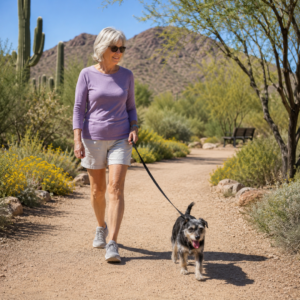
Choose the dog that would be right for you five years from now. I know this is tough to predict, and most of us don’t want to think about it. My dog, Charlie, will probably live another ten years (more, I hope). That means I may start a new life with a new dog at seventy. I hope to be strong and healthy at seventy. The question is, do I want a large, active adult retriever (for example) who needs a lot of exercise and pulls on the leash and jumps on me when I come home at seventy-five? No. Of course I would train him. But training a large dog is still a physical endeavor. Better if I choose a smaller dog, something cute and cuddly, please.

Choose to have the hard conversation. We are used to outliving our dogs. Eventually, one will outlive us. This is difficult to imagine now when we are healthy and enjoying life more than ever. We should think about it, though. If death comes for me at seventy-five, who will take care of my beloved little five-year-old dog? All of us, without exception, need to have a care plan for our dogs, a safety net for them in the event of our passing. Talk to your younger family and friends. Get a commitment and put your wishes in writing.

If you have money — and I know some of you do — consider what one of my clients has done. She set up a trust for her dogs. It’s in her will: money (a considerable sum) for their care after her passing.

I want to have a dog my whole life, she told me one day after our training session.

I smiled. Of course, you should.

Imagine it: graying hair and graying muzzles, slow walks, evenings in your favorite chair. It’s all possible. Choose well for the years you’ll have together. And when the time comes for either of you to say goodbye, know that you planned well, loved deeply, and gave each other a life worth remembering.


Michael Baugh teaches dog training in Sedona Arizona, Houston Texas, and online everywhere. He specializes in aggressive dog training.