 Michael Baugh CDBC CPDT-KSA
I let my dogs off-leash sometimes in our neighborhood in Houston, along the walking path by the drainage ditch. I bring treats and practice recall. I get ahead of them when we pass access points where other dogs might emerge. I keep my phone in my pocket. I watch them. But here’s the deal. Every time we take off our dog’s leash in the name of giving them a chance to run wild we put them in danger. Real danger. I know this. And I’m sharing my confession so that you’ll know it too. Letting our dogs off leash in public places is dangerous to our dogs.
A few years back a woman called me to ask about training. She’d been walking her large (80 lbs) mixed breed dog on a leash. A small chihuahua mix had run up off-leash barking and nipping at her dog’s legs. Her dog picked up the little one, shook it twice, and dropped it. The chihuahua mix was dead. It was that fast. No fight. No fuss. Just dead. That could be our dog. Not the big one on leash. The little one. The dead one.
But Michael, you might be thinking, that’s a rare thing. I’d like to think that, too. Unfortunately, though, I know better. Dogs killing other dogs is a real thing. Even if they are similar in size it can happen. I recently worked with a person whose dog bit another dog. It was relatively minor, just a couple of punctures. But the wounds got infected. The dog got sick. And, then the dog was dead.
I’m not here to tell you that letting our dogs saunter or trot along side us (or ahead or behind) off-leash is wrong. Of course, we already know that. We know it’s illegal too. That’s not the point. I’m here to remind us what we so often choose to forget. It’s dangerous. It’s dangerous to our dogs.
Humans who are walking their dogs lawfully on-leash can get mean in a hurry, let me tell ya. They yell and they curse if your dog runs up to theirs uninvited. They will defend their dogs and their righteous position vociferously.
- But my dog is friendly. “I don’t give a f”.” They will yell.
- He just wants to say hi. “Get the f’ out of here.” They scream.
- He’s well trained. “Really? Call him the f’ back to you.” They retort.
- We do this all the time. “That doesn’t make it okay,” they claim “it just means you’re a f’ing repeat offender.”
Always the F-bombs. That’s pretty standard. They are angry, they and their leashed dogs barking like crazy.
But here’s the thing that’s really dangerous. Humans walking their dogs on-leash will actually hurt our dogs, especially if a fight breaks out. They will kick our dogs. They will spray them with citronella or pepper spray. They will throw rocks. And seriously, a lot of folks are armed. They will shoot our dogs. It’s happened. Don’t think it hasn’t.
But Michael… That’s illegal, you might be thinking. You can’t discharge a firearm in city limits. Fair enough. Take them to court. But dead is dead. There isn’t a judge in the county who’s going to bring our dog back. Hasn’t happened yet. Never will.
A few days ago we were walking our dogs here in Arizona on a trail in the shadow of the red rocks. They were on-leash. A couple of women on horseback rounded the bend. Their two large and beautiful dogs wove ahead and beside them. It was like a scene out of an old western. We stepped far off the trail to let them pass, hoping their dogs would saunter along with them. But, that’s not what happened.
Their young, unfettered dogs ran right toward ours. “It’s okay. They’re friendly,” one of the women hollered from atop her horse. Tim, my husband, picked up Stewie, our chihuahua mix, and stepped farther away. I stood with Stella, our old arthritic retriever, yelling for them to call their dogs back, afraid of what was going to happen, angry, wishing I had a stick or a rock or some pepper spray. Or a gun. I wish I could say I was cool in the moment, eloquent, acerbic and wry. I so wanted to set the scene right with some perfectly placed F-bombs and a mic drop at the end. But that’s not the way it went. I was just the sputtering guy gripping his dog’s leash while a collective 130 pounds of I-don’t-know-what’s-about-to-happen ran towards us.
Life happens fast. We are all caught off guard. Even when we think we are being safe, there are always cracks in the plan. I’m a good trainer. But, no matter how well our dogs’ recall is trained, there’s always a breaking point. Always.
Dogs are fast. Very fast. They approach too fast; the leashed ones are ratcheted back too fast; the fight starts too fast for us to see it coming. The dogs get hurt. People get hurt. I’ve had clients who showed me photos of gaping wounds on their own arms. They were trying to pry a dog off their dog – or their dog off another. In that moment, I’m told, no one thinks about the justifications for what they did or what they failed to do. It’s just a scramble. It’s an uncoordinated rush to get the dogs apart. It’s a f’ing mess.
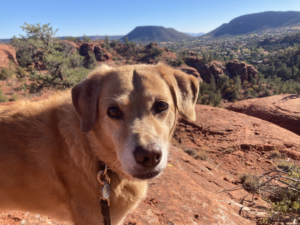 On the trail the other day, the approaching dogs slowed to a trot, circled around me and Stella once and approached politely to sniff her. They really were good looking dogs, big, strong, elegant.I know better than to yank up on Stella’s leash. So, I let out a bit of slack and let her sniff them as well. Then I called her away to follow me. The other dogs wandered after the horsewomen, if not into the sunset then into the shade we were still throwing at each other as they plodded off.
But Michael, what are you trying to say here, you might be asking. I don’t know, really. Confessions are tricky that way, especially the personal ones like this. I’ve had many clients and friends, too many to count, who’ve stood terrified and vulnerable just as I was on that trail. They endured incidents like this one but not like this one because they did not end as well. Dogs were hurt (some killed). People were hurt (some seriously). There was physical and emotional trauma. Behavior care for the dogs. Therapy for the humans. Lawsuits. Lives turned sideways and upside down. Suffering all around.
Our dogs have never run up to another dog when they were off leash. That’s the truth. But here’s the other truth: a lot of our success has been good luck and luck aways runs out. So, maybe this is a cautionary tale with a stretch toward empathy. I’ve been that guy – the one with the friendly dogs romping off leash – and the one white-knuckling the leash bracing for the dogs romping toward him. And honestly, I don’t want to be either of those guys again.
Confessions and cautionary tales and empathy all have this in common. In our best moments each is impetus for change, real change, a change in our behavior. I love my dogs. In fact, I’m fond of most of the dogs I meet. And when cooler heads prevail I actually like most dog people, too. So, when all is said and done the only real questions left are: How to we keep our dogs safe? How do we help keep other dogs safe? How do we get to know and enjoy the other dog lovers who come into our lives?
But Michael, you might be thinking, why don’t you just leash your f’ing dogs?
Michael Baugh teaches dog training and specializes in aggressive dog behavior. He lives in Houston TX and part-time in Sedona AZ.