
Dog Fanatics

Michael Baugh, CPDT-KA, CDBC

If I think about it for any length of time it boils down to this.  There are two types of people in life: Ones who are fanatical about dogs, and ones who aren’t.  I’m here to reveal myself as being among the former.  Though I will also admit, I sometimes don’t understand either group very well.
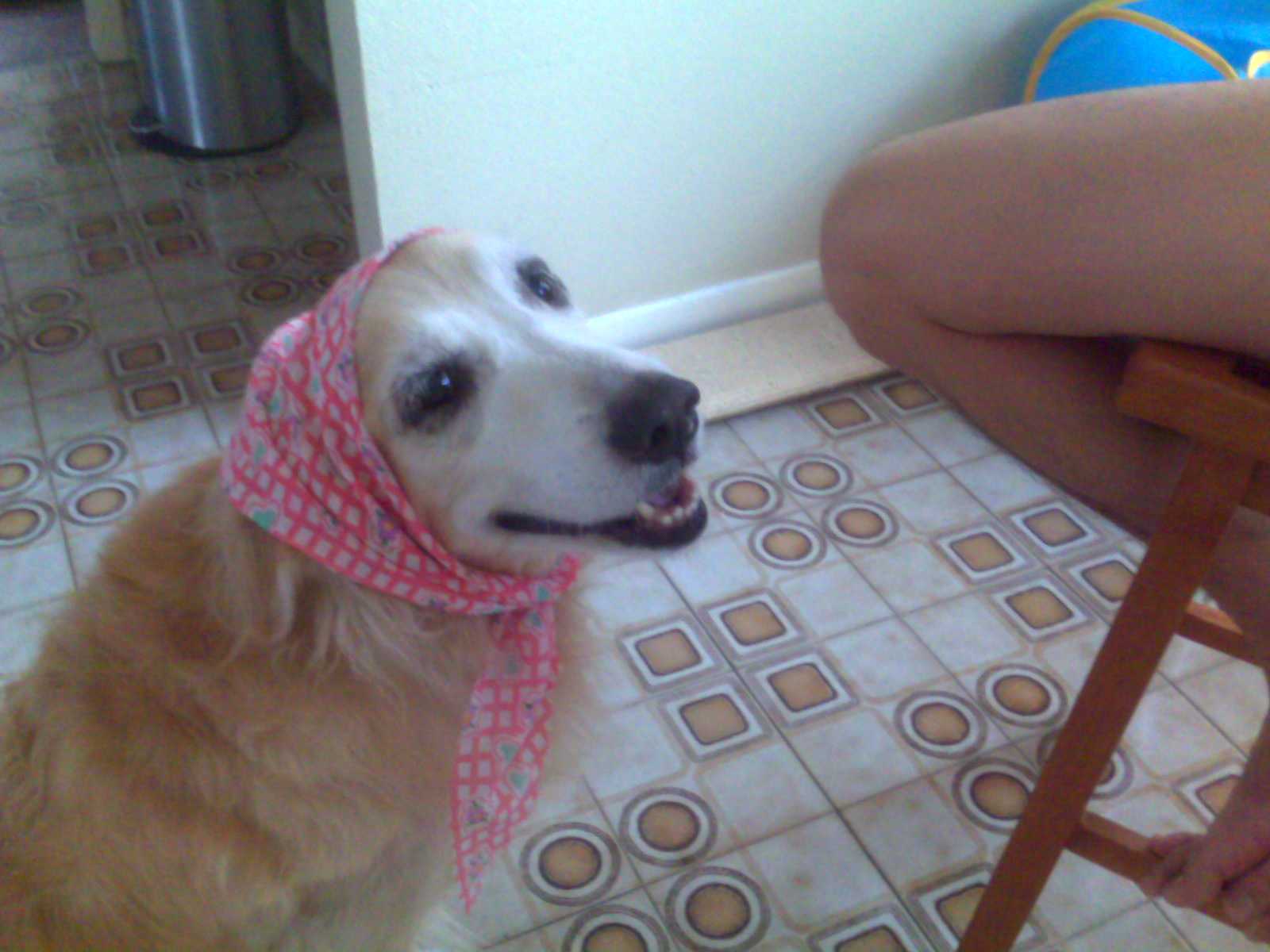
Juno (1998-2009) playing dress-up

Dog fanatics (simply calling them “fans” doesn’t quite suffice) often don’t have human children,  They consider the dogs their children.  We fanatics also recognize, and will gladly tell you, that dogs possess and demonstrate virtues that human beings, including human children, simply do not.  Dogs are deeply forgiving and kind.  Their anger is usually explainable, if not justified.  They are natural creatures who play by the rules without trying to bend or manipulate them.  Yes, we sometimes dress them up, especially for Halloween.  Yes, we talk to them even when no one else is around to hear.  Of course, we tell them secrets.  And I know you didn’t ask, but we kiss them too.  A lot.

If you still don’t understand “dog fanatic,” here it is in one sentence.  We put dogs on a pedestal where we firmly believe they rightly belong.

Then there are those who are unashamedly not dog fanatics.  I met a woman recently who boldly admitted she didn’t like dogs.  The shock that followed was not so much a result of what she’d just told me.  It was that I had nothing to say in return.  I was proverbially and literally speechless.  What could I possibly say to a woman who would admit such a thing?  “At least,” I thought, “you are honest about it.”

A few weeks later I saw my boss at work with a dog I didn’t recognize.  When I asked her about him, she told me he’d been left in front of the building in a crate with a note attached.  We can no longer afford this dog.  His food and care are too expensive.  We can’t afford to take him to a shelter to get rid of him.  Please find him a new home for us. My boss is a leader among us dog fanatics.  Her face was shell shocked.  I, again, was speechless.  I know what it was that cut us both to the emotional quick.  Get rid of him. He was clearly a sweet and gentle boy.  Who would simply get rid of him?  Who would leave him like this?  Who, in leaving him, would fail to leave the dog’s name on the note, one bit of dignity, a simple goodbye?

Find him a new home. The people who abandoned This Dog won’t read this column.  On the off chance they do, I should tell them there are painfully few new homes for dogs.  There are shelters staffed with kind-hearted people, some volunteers, who suffer the truth of the neglected dogs in their care.  There are shelters, haunted by loneliness and disease.  There are shelters, where some dogs are adopted but many more are not.  Find him a new home?  This Dog. My boss turned away from me.  There were unspoken expletives in the air.  “We are a horrible species.” I said, and that was all.

I thought for a moment of my own dog, Stewie, running in a storm not far from the place where I work.  He had no tag, no microchip.  No one responded to the signs or web postings that he’d been found.  He’s a good boy too, like This Dog. I found my Stella at a shelter and saw her through distemper.  She probably never had a home before mine.  As I write this, their bellies are full and their hearts are at peace.  Tonight they will cuddle in my bed before retiring to their own.  Tomorrow they will go to work with me and romp in doggie daycare.  If I were down to my last meal, I’d share it with them.


I don’t understand those who are not dog fanatics.  Equally, I’m sometimes perplexed by those of us who are.  When I joined the ranks of the insanely in love with dogs, things seemed clear enough.  Dog is god spelled backwards.  The righteous praise and love them.  Those who neglect and abandon dogs are the villains.

The truth, controversial as it might be, is not so clear.  I know many dog fanatics who distain fellow humans in equal measure.  Some are deeply unforgiving.  Others are quick to anger.  Often, we fanatics dress each other down, sometimes in public.  Occasionally we cut ties, and rid ourselves of others altogether.  The truth is stark.  We put ourselves on a pedestal and believe firmly it’s where we rightly belong.

So, perhaps this first column is a confession.  I heard the story of This Dog and said, “We are a horrible species.”  What did that say about me?  Is that what I really believe?  The people who care for suffering dogs suffer the most.  They are the people who work at shelters, and the people who volunteer for rescue organizations.  They are good people who see horrible things, who see humans at their worst.  They love dogs, and sometimes lose the fight to save them.  How easy is it then to lose hope in our own kind?  Maybe that’s why we turn on each other, on ourselves, even on other dog fanatics.  I’ve done it myself.  I confess.

My boss is a leader among us dog fanatics and I admit sometimes I don’t understand her.  There she stood that morning with This Dog, ready to take him to the vet for some shots and a fresh start.  Her look turned from shock to stoic determination as she turned and walked away, clutching his leash in one hand and the painful note she’d found in the other.  There was a lesson in the sight of them together.  She’s a good woman.  He’s a good dog.  Their strength together was quiet humility in the face of injustice.  It’s an old lesson I keep forgetting.

“We are a horrible species,” I said, and almost immediately I wished I could take it back.

The Science of Dog Training


Michael Baugh  CDBC

Some things trainers teach are simply their opinion. Others are the opinions shared among many trainers. Then there are the facts, verified and peer-reviewed. The latter is what this article is about: the science of dog training.

If your dog does something, and a well-timed favorable outcome follows that action, the behavior will happen more frequently in the future. Edward Thorndike served up that gem back in 1905. It’s been tested so many times it’s known as Thorndike’s Law of Effect.

We know this, too. We can give or withhold good things to influence our dog’s behavior. That’s the core thinking behind Skinner’s famous Learning Theory. Our dogs control their own behavior, but we can sway their choices. How cool is that? The dog jumps up; he gets nothing. The dog sits nicely; he gets something nice. What do we get? We get less jumping and more sitting. This is probably the most scientifically tested piece of psychology on the planet. Good things happen; behavior increases. Good things don’t happen; behavior decreases.

It gets better. We influence something else too. We can create cues in the environment, like certain words, hand signals, and situations, to trigger behaviors. It’s not trainer magic. It’s behavior science. The cue “sit,” for instance, informs the dog that something good might be afoot. He plants his booty on the ground because he’s learned that’s a safe bet. Bingo! Here comes the goodie. Sit, then, becomes a powerful word.

Okay, let’s geek out a little. All this boils down to A–B–C. That cue we were talking about is the “A.” It’s called an antecedent: the cue. The “B” is for behavior (what the dog does). The “C” is the consequence, giving or taking something away to influence a change in behavior. That’s Learning Theory. “A” (antecedent): Doggie, come! “B” (behavior) he runs to us. “C” (consequence): We throw his favorite ball for him to fetch. Brilliant! Now, here’s the rub. This process is still always in play. Our dogs are learning just about every waking hour, even when we’re not around. Check this out. “A” (antecedent): Leftovers on the counter. “B” (behavior): The dog lifts himself onto the countertop for a sniff. “C” (consequence): the whole thing ends in a tasty snack. Our dog just learned a new trick, and we had nothing at all to do with it.

Good dog trainers and behavior consultants know this stuff backwards and forwards. We’ve studied it, watched it at work, and applied it in the field. I won’t bore you with all the minutiae of contingency statements and functional analysis (okay, I might a little). Instead, let’s look at any behavior problem and ask: What is the dog actually doing? That’s the behavior itself, like jumping up on the counter. It’s not an interpretation of behavior like, “he’s dominant” or “he’s trying to get back at you.” (That’s non-science). Then, let’s ask, what’s triggering the behavior? There’s your antecedent, in this case the sight of the countertop itself. Now, what’s keeping the behavior going? Ah, the consequences! Sometimes there’s food up there.

Move a few puzzle pieces, and the picture changes. We can control antecedents and consequences. Adjust those, and sure enough, your dog changes his behavior. That’s what learning is all about. In this example, keeping the dog out of the kitchen is a good way to avoid the antecedent. Clearing the countertop removes the potential for a yummy consequence. Teaching the dog to put his nose to work elsewhere is even better.

Practice your ABCs. This science left the laboratory a century ago. Skinner’s students took it on the road in the 1940s, training animals for carnivals, movies, TV, and the military. Sea mammal trainers eat, breathe, and sleep it. It’s at work right now in your own home.

Applied well and gently, science-based training is the stuff of good communication with your dog. Applied lovingly, it’s the path to a deep and abiding friendship. Of course, that last part is simply my opinion.

Michael Baugh teaches dog training in Sedona and online to dog lovers worldwide. He specializes in fearful and aggressive dog behavior.

A Culture of Learning

Stella. Courtesy Robyn Arouty Photography

Michael Baugh, CPDT-KA, CDBC

Folks ask all the time, “How often should I train my dog?”  I’d like to be able to say every day, all day; your dog is always learning.  But people want structure so instead I recommend short sessions (clicker training) several times a day totaling 30 to 40 minutes a day.  They are both the right answer.  Still, I like the first one better.

Weave training into your everyday life.  Make your relationship with your dog a culture of learning.  That’s the best way.  Now, I’m not really talking about making your dog wait for you to pass through a doorway first.  It’s not about requiring him to sit and stay before you put his food bowl down.  It’s not even about demanding he sit nicely instead of jumping on your guests.  Don’t get me wrong.  Those are all very nice manners to teach your dog.  But, I’m talking about a different culture of learning, one that has nothing to do with making, requiring or demanding.

It’s about noticing.  Here’s a little bit of dog-trainer-geek science.  A behavior with a favorable outcome (for the dog) is more likely to be repeated.  It’s called Thorndike’s Law of Effect.  Scientists don’t hand out that word lightly: Law.  Thorndike’s law of effect is just that, a law.  It’s been proven, tested and re-tested.  That gives you a lot of power when it comes to training.  There are lots of favorable outcomes you control: food, playtime, petting, warm smiles and praise.  That means you can get a lot of good behavior on the “repeat cycle” of your dog’s repertoire just by leveraging those favorable outcomes.  It’s how clicker training works.  Your dog does something cool.  You click and treat.  The dog does that cool thing more.

Okay, what does that have to do with noticing, specifically noticing your dog?  Life doesn’t happen in 10 minute clicker training sessions.  But our dogs are always learning from us and from the environment.  Thorndike’s law of effect is always at play.  That means it’s up to us to always be aware of what our dogs are doing, watching for good behavior that we can reinforce (favorable outcome), noticing.  That’s the culture of learning I’m talking about.  Notice when your dog does something right and be ready to let him know that’s what you like.  Now you’re teaching your dog every day, all day.

This may seem difficult, but read on.  We humans seem to be pre-programmed to notice when things go wrong not when things go right.  While I was writing this my dog, Stella, came over to check in with me.  I love that behavior but I ignored it.  Later she started barking out the window and she earned my full attention.  That’s the way people are, but it’s backwards training.  Stella learned that checking in with me got her nothing (no favorable outcome) but barking got my attention (favorable outcome).  I ended up on the wrong side of the law, Thorndike’s Law.

Notice.  Your dog does great things every day.  Never miss a chance to pet him when he sits nicely and gazes at your adoringly.  Smile and rub his belly when he curls up at your feet.  Throw a party when he comes when called.  Then throw the ball and play for a little while.  It’s worth it.  And it’s a good way to live.  Notice what’s right with your dog and be glad.  Then notice the people in your life – even the ones you don’t know – and the world around you.

There’s a lot of good going on.  Click and treat.