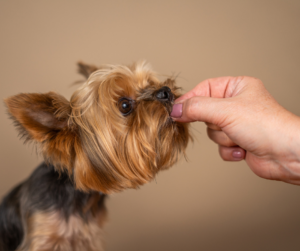
Dog Training: Bribe vs. Reinforcement


Michael Baugh CDBC CPDT-KSA

Using food in training is not the same as bribing your dog.

First of all, a bribe is primarily a human transaction. It’s a promise of a future renumeration for something the bribed will do now or very soon. Bribes are nefarious dirty deeds. You bribe politicians, not dogs. Dogs don’t think that far ahead and politicians … well, I’ll leave that alone.

Semantics aside, I get it. Some folks seem to be very concerned that their dog is “doing it for the food.” Of course all of us work for money and I’m not above doing a bit of work for sushi or an iced latte. That seems to be okay. Work for free? Anyone? Anyone? I doubt it. But, a lot of us get downright  insulted if our dog won’t work for free. We want her to do it “just because it’s me.” Why? I don’t know. That question might be better left to an expert in human behavior.

In dog training our main concern is when the treat shows up.

  • Before the behavior. We show the food ahead of the thing we are asking our dog to do. Think: calling our dog to us as we crinkle the treat bag. Or, cueing our dog to sit with food in our hand. Okay. If we are speaking in the vernacular we could call that a bribe. We are showing the food out front. Generally this is not the way to go. Though there is a notable exception I’ll explain below.
  • After the behavior. The dog does the thing, whatever the thing is, and we follow up by giving her a bit of food. The food lets the dog know the behavior pays. Do more of it. That’s called reinforcement. Sit – treat – more sitting. It’s how nature works.

The notable exception. Our dogs rarely know what we want at first. One reliable way to teach a new behavior is to lure the dog into the action or position. This does involve showing her the food ahead of the behavior. Good trainers (and you’re a good trainer) plan to get the food lure out of the mix as soon as possible and focus only on reinforcing the behavior after it occurs.

All that said, is our dog just doing it for the food? Probably. Some behavior goes away very quickly if we drop the food altogether, especially if there are competing motivators.

Is our dog always just doing it for the food? No, not always. The world is full of reinforcers, some stronger than others. It’s up to us as trainers to stay creative and see what our dog will work for. What motivates her? Food? Play? Access to other dogs? Keep exploring the possibilities. Keep the conversation with your dog going. It’s how we build trusting relationships. It’s how we end up with dogs who are eager to learn new things with us just because it’s us.


Michael Baugh is a dog trainer in Sedona, AZ. He specializes in aggressive dog training.

Make it Stop

Michael Baugh CDBC 

More than anything, we humans just want out dogs’ unwanted behavior (i.e. “bad” behavior) to stop. Barking. Make it stop. Biting. Make it stop. Jumping, running, digging, you name it. We want it to stop.

So, how do we make things stop? One way is punishment. Technically speaking, punishment is anything we apply or take away that decreases a behavior. We humans love punishment, because it often has instant results (though, often not very lasting results). See: The Allure of Punishment.

The trouble with punishment is that the standards are quite high if we want to see any long-term effects.

  • We have to punish at a level that is sufficiently crummy for the dog. He either loses some very desirable privilege of gets some level of painful nastiness (and most of us don’t really want to hurt our dog).
  • We have to punish in a timely manner, like the moment the bad behavior occurs. We humans are notoriously bad at timing.
  • We have to punish every occurrence of the bad behavior. Every one. No exceptions.

If we don’t met the three criteria above, then punishment will fail.

Fortunately there is an easier way to end bad behavior without having to jump thorough all the difficult hoops of punishment. We can, without much hassle, teach our dogs what we want him to do. This is a proactive approach to training. What behavior do we want our dog to perform instead of the unwanted (bad) behavior?

There are technical terms for this. One of them is Differential Reinforcement of an Alternate Behavior (DRA). But, I like to simply call it giving our dog a landing spot. Don’t do that. Do this instead.

Here’s more good news. Most alternate behaviors (replacement for the bad stuff) are very easy to teach. It’s simple stuff like stand, sit, and lie down – things our dogs do anyway. I came up with this short list of unwanted behavior and simple solutions to fix them below. It’s a short list but it gives you an idea of how this works.

  • Stop jumping on guests becomes stand with all four paws on the ground. Reinforce with food and petting.
  • Stop biting guests becomes go lie down over there on your bed or mat. Reinforce with food (keeping guests away from the mat or bed is also reinforcing).
  • Stop pulling on leash becomes walk beside me and check in every once in a while with a glance up. Reinforce with food and praise.
  • Stop barking out the front windows of the house becomes come when called and hang out here with me. Reinforce with food, praise, play, etc. (Limiting access to the front windows also helps).

If a behavior problem seems too complicated for you to figure out, certainly bring in a qualified positive reinforcement trainer or behavior consultant to help you come up with an alternate behavior (or series of alternate behaviors). But, for the most part, this is pretty straight forward. Take your focus off the stuff you don’t want your dog to do Put your mind and your energy into what you want him to do instead.

In other words, teach your dog to do something.

Michael Baugh Teaches dog training in Sedona AZ. He specializes in dogs with problem behavior including aggression.

How We Feed Our Dogs Can Make Them Smarter


Michael Baugh CDBC 

Feeding our dogs from enrichment toys, toys that dispense food, can actually make them smarter. It definitely seems to make them happy. Puzzling out the food inspires activity and thought. A lot of trainers liken it to the skills a scavenging dog or a hunting dog would need in order to eat the food they’d found or killed. Other trainers, me included, have noticed that it helps our dogs focus, activating their brains in a way boring bowl feeding simply doesn’t.

Food-Toy-BW (1)It turns out we’re probably right. Animals (and human animals) who successfully learn challenging skills are more likely to be successful at subsequent challenging skills. In other words, succeeding at hard stuff makes us better at doing more hard stuff.

The research actually dates back to the late 1970s. I came across it in Angela Duckworth’s great book, Grit: The Power of Passion and Perseverance. She cites the research of Dr. Robert Eisenberger from the University of Houston. He showed that rats that mastered a complicated task to earn food pellets, pressing a lever multiple times, we able to master subsequent complicated tasks (like running a maze) more easily. In fact they learned new tasks with more vigor and endurance. He ran related studies with children and college students in the 1980s with similar results. Eisenberger called the process Learned Industriousness. 

Are our dogs learning to be more industrious because we feed them from food-dispensing toys? I think so. The task-based eating process is similar to what Eisenberger used, teaching the animal to work for the food.  It also aligns with what many clicker trainers have observed. Dogs who learn tasks seem to learn how to learn. As they come to understand the process, the learning seems to come faster.

Almost all of my clients report that Mat Work, teaching their dog to lie on a mat, helps the dog become more focused. Mat Work is fairly complicated because it challenges the dog to figure out what do do with the mat (lie down on it) on his own. We don’t provide instructions, only feedback via clicks and treats. It’s a puzzle for the dog to solve. When we set it up properly and provide honest and clear reinforcement the dog figures it out, usually pretty quickly. It’s a hard skill that sets our dog up for more learning – for mastering other hard skills. In the clear light of Eisenberger’s research, all this seems to make more sense now. For a great primer on how Mat Work works, read Fired Up Frantic and Freaked Out by Laura Van Arendonk Baugh (no relation).

How do we teach our dogs learned industriousness? Let’s start with the toys. There are lots of great food-dispensing toys on the market. For beginners I recommend the Bob-A-Lot (pictured above). It’s perfect for feeding dry food. I’m also a big fan of the KONG Classic, which truly is a classic. Both are available online and at local retailers.

Michael Baugh KPA-CTP CDBC CPDT-KSA teaches dog training in Sedona, AZ. He specializes in helping dogs with aggression and fearful behavior