How Dog Training Makes us Better Humans

Michael Baugh CDBC

I come to this work with few ulterior motives. I’m certainly not being manipulative, nor am I conducting any mad scientist experiments (benevolent or otherwise). Admittedly though, there’s a warm satisfaction when I see what dog training does to people.

Training our dogs helps us a great deal. It’s no secret. This is a human endeavor. We benefit as much as our dogs. Reinforcement based (think non-coercive) training helps dogs make better decisions. It helps them behave better. The dog stays in his home, lives longer, and seems more joyful. Humans? Well, it’s a relief when the bad dog goes good. Win-win all around. Everyone’s happier.

But, in my experience, some other things are happening too. I’ve noticed a trend over these 25+ years in dog training. When a human being thinks about his dog differently, when he uses smiles and praise and food in training, when he sets aside his anger and force and restraint, something happens. There’s a change, not just in the dog. It’s a human change, sometimes subtle, but no less real.

This is what I’ve noticed:

We speak less and listen more. Of course, when we think of listening to our dogs, what we really mean is we watch them. Folks who’ve learned how to communicate with and teach their dogs using force-free methods do this a bit differently, though. We really watch our dogs, with soft attentive eyes, like we’re looking at a brilliant painting, or watching a fascinating film for the first time. All the stories we tell on our dogs, all the commands and admonitions, they all fall silent. We change. Not so much the dog, but the human, we change. We stop looking for error and evil and we see out our dog’s goodness, his correctness, and his best moments of simply being.

When we speak, our words flow from kindness. What else can we say? We notice our dogs differently; we speak better of them. They are two human behaviors naturally and inextricably connected. See goodness of being; speak the same. And we smile. We celebrate our dogs with food and play and quiet moments. We connect at a level that seems sometimes hard to explain to others.

And then we cross the line. This is the part so many of us never saw coming. We learn how to be and how to act with our dogs. Our dogs learn how to be and how to act with us. They reflect the lesson back and teach us and before long, so often, the lesson spills over. I’ve seen it happen firsthand. It’s real—inexplicable, maybe—and also undeniable. We treat each other differently. So much in the habit of seeking and supporting goodness, celebrating the actions we love from the beings we love, we do it more. We watch each other with soft attentive eyes. We speak to each other from a place of kindness. It’s God’s work or Dog’s work. Backwards and forwards, it is what it is.

I’ve left people’s homes too many times with butterflies in my gut and an impish (smug?) smile on my face for it to be mere coincidence. Dogs on the line, we trainers know all about them. Families on the line, we talk too little about them. I’m not being manipulative. But once the door is opened, it’s hard to shut. See for the first time how reinforcement changes not only your dog’s behavior but also how you feel about your dog, and you won’t soon forget it. See how it helps create long-lasting nurturing relationships with your fellow humans, with the people you love, and it’s nothing less than life changing. How could it not be?

I’ve seen it happen, witnessed it firsthand too many times for it to be my imagination. After just a few sessions, the dog softens, improves, becomes a better version of himself. But don’t think I didn’t see the other things too: the child and parent smiling and working together, the man in love with his wife more so now because she loves his dog, the family listening—taking turns—encouraging each other, just like they do with the dog.

I’m no mad scientist. In fact, I take no credit. It’s like I tell my clients. I just have some information. You get to make all the decisions. This is all you.

Michael teaches dog training in Sedona, AZ. He specializes in helping families with fearful and aggressive dogs.
Touch Me Not

Michael Baugh  CDBC

It’s one of the most uncomfortable things for us trainers to say to a client.  I am always looking for the kindest and most tactful way to say it.  “I don’t think your dog really enjoys being patted on the head like that.”  It’s tough because the thing is, we humans love to pat and pet and paw on our dogs.

Ethologist and Author Patricia McConnell PhD was one of the first to shine the light on this basic disconnect between humans and dogs.   We humans are primates.  Our social interactions are played out primarily with our arms and hands.  Dogs are canines and they are notably lacking arms and hands.  Their social interactions are played out with their whole bodies, but primarily with their mouths.  So, it’s no surprise then to find new puppy owners bloodied on their limbs and digits baffled over why their young bundles of teeth keep biting them.  It’s also no surprise to see a dog duck away when their person reaches out to pat their head.

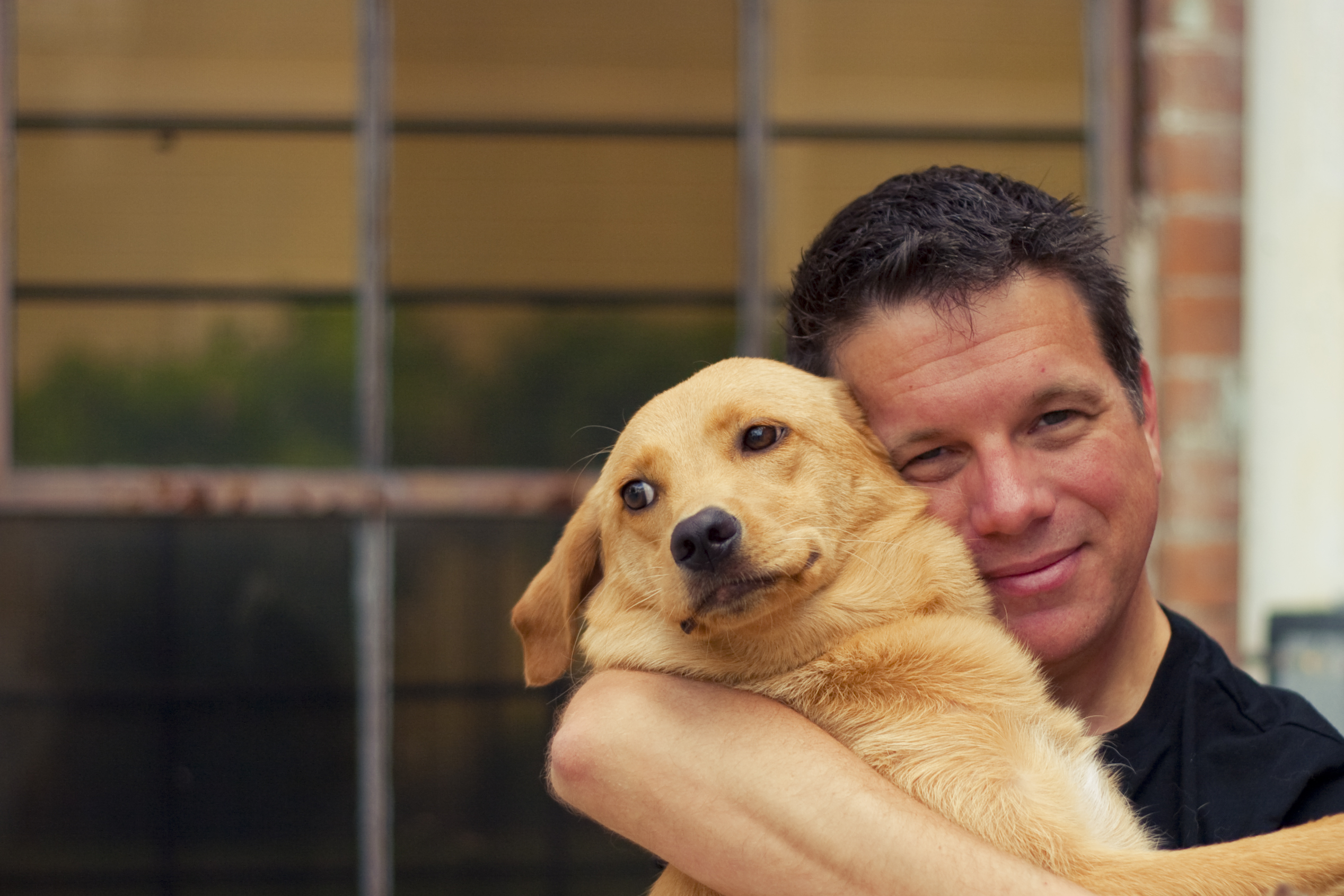
Here’s the rub (literally and figuratively).  Even when we know better, we humans keep on keeping on.  We don’t get it, even when we get it.  Case in point: that picture of me and Stella over there.  My face says, I love this dog.  Her face says, I don’t care just get me out of here.  I knew better but I just couldn’t stop myself.  Facebook and Google are littered with videos and pictures like this one, and worse.  People hugging dogs who clearly are uncomfortable.  Children draped over dogs who are at best tolerating the interaction.  We can’t help ourselves.  Almost daily we’re highlighting the difference between our species, photographing it, and publishing it for the world to see.

Sometimes I chuckle at myself when I forget and reach for Stella’s head for a nice pat.   She, of course, ducks away and I apologize.  The laugh is on me.  I knew better and couldn’t help myself.  Dogs tend to not like hands reaching for them; especially hands belonging to someone they don’t know too well.  Some dogs are more sensitive than others (Stella knows me well and still doesn’t care for that kind of greeting).  We forget because quite often we greet each other, including strangers, with an extended hand.  We call it shaking hands.  If we know each other even a little bit better, or if we’re in Europe, we might hug.  Hugs to dogs are very alien and offensive.  Dogs who drape their heads over another dog’s withers (shoulder area) often get in fights.  So do dogs who full-on mount another dog (sort of like hugging).

People who reach for the wrong dog get bitten too.  Sometimes the results are serious.  Children, unfortunately get bitten most frequently.  They’re the ones most likely to hug or even try to ride a dog.  It pains me to know some parents don’t know better and actually encourage this.  They grab the camera and log on to Facebook.  I cringe.  At least one dog related fatality this year involved a baby pulling himself up on a dog.  Those cases are rare and extreme.  It’s easy to blame the dog or the parents.  The truth though is that we all need to learn better ways to interact with dogs;  we trainers especially need to take the lead on this – teach – learn – teach again.  No one who loves their child and loves their dog wants things to go badly.  But it happens.

This doesn’t mean dogs don’t like to be touched.  Most do.  When I’m thinking correctly, I let dogs approach me first.   If the dog appears fearful, I’ll turn sideways to the dog, and I might bend at the knees to get down to his level.  I don’t reach into the dog’s space or make direct eye contact, the way you might do when you’re greeting a person at a business meeting.  If the dog approaches, I pet him on the chest or on the cheek by his ears.  Watch to see how he reacts.  If he backs away, I stop.  Of course, the overwhelming majority of dogs will love this.  Many will be exuberant and jump for joy (that’s another issue altogether).  Children are always supervised.  In Stella’s case, because she is particularly sensitive, interactions with kids are structured and brief.

Trainer educator Jean Donaldson got it right in The Culture Clash.  We want our dogs to be like dogs the in the movies.  She calls them Disney Dogs.  They are cute and always nice, with human sensibilities and manners.  That, of course, is a myth.  Dogs have their own ways, their own sensibilities, and they are nonetheless still cute and nice.  I think they are more so.  Nearly perfect in fact.

Michael Baugh teaches dog training in Sedona AZ and everywhere online.