
A Look at Inter-Dog Aggression

Michael Baugh CPDT-KA, CDBC

Let’s start with the good news first.  Most dogs are not intent on killing each other.  That’s not to say they don’t have conflicts.  They do; and those conflicts can sometimes be scary, noisy and even hurtful.  Still, in most cases dogs don’t settle the score with fatal consequences.

Play can sometimes look like aggression

In fact, dogs give each other plenty of signals when they are upset about something.  They growl, snarl, lung and even snap wildly at the air.  You’ll hear some trainers refer to that as “ritualized aggression.”  Think: argument or the occasional sign language you see in Houston traffic.  It’s unpleasant and communicative, but not dangerous in and of itself.  There are more subtle nuances as well, the slight change ear posture, facial expression, breathing rate, or pupil dilation.  When it comes to their own kind, most dogs are expert communicators.  The reason is simple and serious.  Real fighting is costly in terms of both risk and expended energy, so dogs have to be very good at resolving things without physical conflict.

If we step back a bit we can see most inter-dog aggression is about stopping some perceived threat and making the other dog go away.  Increased distance often resolves the argument.  This is most obvious in dogs who guard food and objects from other dogs.  It’s also evident in dogs who lack experience interacting with other dogs.  Animals, including the human animal, tend to reject things they don’t understand.  Dogs who aren’t familiar with their own kind keep their distance.  They might run away and hide as adolescents and young adults.  Later as more mature adults, they might put on an aggressive display or worse to make the other dog go away.  Either way, the message is clear.  “Stay away from me.”

The real trouble arises when the dogs can’t properly communicate, and when one or both of them can’t retreat.  They’re trapped.  This is especially true in the case of dogs who are specifically aggressive towards other dogs while on leash.  It is, perhaps, the most common form of inter-dog aggression.

It begins with well-meaning people who take their new dog or puppy on a walk for the first time.  The dog, naturally curious, pulls toward other dogs he sees out in the wide world.  He may even bark.  The owner, frightened or angered by the pulling, yanks back on the leash yelling “heel” or “no bark.”  Trying to stop the problem, the person might invest in a choke or prong “training collar” for his dog.  Then, even if the dog begins to pull less, the owner keeps tension on the leash every time another dog is near just in case.  As the weeks and months roll by, the dog learns that whenever he’s on leash and other dogs are around things get a little scary and maybe painful.  He’s unable to investigate his own kind, and his owner is freaking out (or at the very least anxious).  Before long the pulling and barking turns into lunging and growling, plus more yanking on the leash and yelling.  Now dogs on walks are no longer a curiosity but a trigger that something bad is going to happen.  We don’t know for sure what the dog is thinking, but we can imagine it might be “Get out of here dog, you’re making my owner freak out and he’s choking me.”  Imagine how much worse this becomes if the other dogs in the neighborhood are trapped in this same cycle.

Prevention is always easier than a cure.  Would that we could turn back time and stop the cycle before it starts.  We’d teach our young dogs and puppies how to meet other dogs while on a leash.  We would hold the leash without pulling it taught; we’d keep the line slack while two friendly dogs sniffed and circled each other.  On our best days, we’d chat up the neighbors and admire each other’s dogs.  Some days our dogs would play in an enclosed area off-leash.  Each day we and our dogs would become more social.

Fixing the problem takes more effort.  However, there is help.  Qualified dog trainers and veterinary behaviorists can outline a plan that includes protecting your dog from having more aggressive displays.   The plan will also involve reward-based training, teaching appropriate behavior while helping him feel better about his own kind.  The prognosis is usually better with younger dogs, but there is always hope.

Dogs, I’ve discovered, are amazingly adaptable.  At their core, they are social animals.  Even the hardest cases can and do show some improvement.  I guess that too is the good news.

Michael Baugh specializes in aggressive dog trading in Sedona, Arizona
Look and Listen

MICHAEL BAUGH CPDT-KA, CDBC

HOUSTON – A lot of people think their dog has selective hearing when it comes to basic obedience cues, especially coming when called.  No matter how many times they call their dog, it seems he’s just not listening.  Some folks even worry their dog may be ignoring them out of spite.  Fortunately, that last one probably isn’t true.  He just hasn’t been trained yet to tune into you when you call.

It turns out the key to really effective dog training isn’t so much about listening.  It’s about teaching your dog to look at you.  Dogs who are keeping their eyes on you are also keeping their ears attuned to what you are saying.  In fact, most precision obedience training is really about the dog’s visual attention, not his listening.  Dogs actually learn visual cues (hand signals) more easily than they learn verbal cues (words).

Start at the beginning.  The first thing I recommend people teach their dog is eye contact.  It’s important that dogs learn to focus their attention on our faces.  It sets them up to catch our verbal instructions on the first go around.  It also allows them to better read our facial expressions for feedback on how they’re doing (dogs are experts at reading human facial expression, even subtle change in our expressions).

Here’s how to do it.  Keep some of your dogs kibble in your pocket.  Every time you catch him glancing up at your face say “yes.”  Then, immediately follow up by giving him a piece of his food.   This is called capturing a behavior.  In a short time, your dog will be watching you all the time regardless of whether or not you have food on you.  Once you he’s doing that you can start calling his name (only say it once please).  When he responds to his name with a look up to your face, immediately say “yes” and treat him.  Repeat this often so that his name becomes like a magic word that draws your dog’s attention to you immediately every time.

Before long your dog will be glued to you, watching attentively for further instructions.  Your friends will all say, “Wow he really listens.”  Of course you’ll smile and agree, because you know he’s looking at you.


(from myfoxhouston.com)

Swim Stella, Swim!

Michael Baugh, CPDT-KA, CDBC

“This dog can’t swim.”  That’s what I thought as I watched her struggle, bob and tip in the pond.  I was about to jump in the murky water myself when I saw Stella briefly roll onto her back and then right herself.  She stepped gleefully to the shore, shook off, dropped her ball, and looked up at me.  She had no idea how pathetic she had looked.

Of course, I was concerned.  Stella had swum before, albeit briefly.  But, this last time was different.  Physics failed her.  She listed to one side, nearly sank, and then went keel up. She was wholly out of her element, and I’d so wished her element was water.  I wanted it badly; I wanted it with every memory of the retriever before her, with every hope of the retriever I dreamt she would become.  That was the problem.  This wasn’t about me.  It was about Stella; and Stella couldn’t swim.

I tried to get my brain around it.  Maybe it really was bad physics.  Stella’s chest is unusually deep and her waist is unusually small.  She’s narrow, very narrow.  She’s tall and long, unnaturally so.  Her face and coat say retriever, but the rest of her says whippet or Italian greyhound.   Okay if I’m going to be brutally honest, if you catch her at the wrong angle the whole package screams “cartoon dog.”  Maybe her body just wasn’t built for water; maybe she was too lean, too spindly.  Maybe she just couldn’t swim.

When my heart’s breaking, I write.  So, I wrote some veterinarian friends of mine.  No, they said.  There’s nothing wrong with Stella.  She is quirky beautiful and fully buoyant.  I wrote to a local dog swim coach (who knew?) and she said the same thing.  Some dogs are naturals, others are not.  Stella can learn.  She can swim.

I can’t explain what happened next.  Sometimes there’s no way to fix a thing set askew.  Then again, sometimes there’s no holding back a thing intent on setting itself right.  Stella’s new coach is an affable woman in the middle of life, with an easy smile and a gentle feel for a dog’s spirit. She welcomed us to a long glistening pool in the early light of day.  “Does Stella like toys?” she asked.  “Tennis balls” I answered.  The rest was unstoppable.  It was the simple magic of letting things happen, letting go, swimming with the current of the moment.

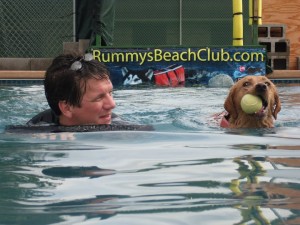
Stella waded into the pool for her ball, and brought it back.  On the second throw, she leapt across the shallow slope into the deep.  Stella’s head slipped under and then popped up high in the water, a bow splashing and awkward, and a stern dragging too low.  Her coach moved with deft purpose, the subtle speed of a woman who knows her craft.  She righted Stella’s hips, bringing them level to withers just below the water’s crest.  Stella sailed with ease back to the shallows and out.  She dropped the ball and looked back at what she’d swum.

courtesy: Rummy's Beach Club

I threw again.  Again she leapt and swam.  Again, and again Stella’s body stretched, and her head skimmed the break where water meets air.  Her legs tucked naturally, fronts propelling, backs adjusting for balance.  She used her thick retriever tail like a rudder.  Stella leapt and swam.  She moved with ease and grace, ball firmly in mouth, eyes gleaming in the morning sun, nowhere to be but here, nothing in mind but now.  Stella leapt again and then swam some more.  She panted and pushed hard against the water, a wake behind her.  The air was sweet with the smell of wet dog and abandon.  I moved up beside her and kissed her cheek.  I would have loved her the same no matter, but oh how I love my water dog.

We stayed on like that until we were both soaked through, swimming together.