
Mindful Dog Training – Showing Up

Michael Baugh CDBC, CPDT-KSA

I once wrote that I fell in love with my dog, Juno, while we were practicing “stay.” We were across the room from each other at a busy training class. She was a good 20-feet away, but we were so very close, watching each other intently, fully in the moment. It was magical and I’ll never forget it.

Humanistic Psychologist Carl Rogers said this presence, this connection, is key to all healing and learning relationships. It’s not just about physically being there, going to class, pulling out the clicker and treat bag and doing the session. Instead, it’s about making genuine contact. Rogers (who didn’t have dogs) referred to it as psychological contact.  Some trainers say it’s like being in sync or in the zone with their dog. For me it’s about showing up in a very real and committed way. Stop, step away from the rest of the world, make eye contact and share a moment (or several moments) with your dog.

DSC00626For those of us who are clicker trainers, this sweet spot of connectedness is very accessible. So much of how we teach our dogs is about noticing them, what they are doing, how they are moving, even what they are looking at. We have to step away from the cacophony of everyday life to experience this. How else could we adequately capture and shape behavior? We’re providing feedback to our dog who, quite literally, is figuring out a training puzzle. We’d better show up, pay attention, be present. This is communication at its best, both actors fully aware (dare I say mindful), and in contact – psychological contact. How cool that so often not a single word is spoken.

These intense learning moments are a great and necessary joy. But, for me, they are not enough. The days are busy and the outside forces on our lives are relentless. We get into our routines and the work of training can sometimes feel done. We get swept up in jobs and traffic and email and the comings and goings of friends – let’s meet here – so good to see you – we must do this more often. We feed the dogs, take them out, maybe for a walk while we check social media on our phones. They seem fine, these easy-going noble creatures. The dogs are fine. So patient. So forgiving. But it’s not enough – not for them – not for us either.

Have you every felt a rush of joy when you look directly at your dog and see him looking back? Does the room seem to quiet down? Does your breathing slow a bit? These moments actually cause a release of the hormone Oxytocin. The love we feel is physical – measurable. Our dogs have oxytocin too and it’s a two way street, this hormone induced warm-fuzzy feeling. I can feel it when I train, but that’s not the only time. Oxytocin helps us bond with each other, other humans, and apparently with our dogs too. By all accounts, it’s good for us. It keeps us sane and psychologically connected. But, once the training ebbs and eventually fades away, how to we recreate these important moments, and the powerful  feelings of wholeness and relationship that come with them?

Stop, just for a moment or two. Step off and away from the world.

Every day (usually several times a day) I get on the floor with my dogs. It’s easy and I like easy. I put the phone away, leave the TV off, and set human conversation aside. Stella and Stewie and I just hang out. We show up and hang out. Sometimes Stella brings me a ball. More often now she sidles up for some petting while Stewie cuddles in my lap. We stay this way for as long as we can, with a nod to Dr. Rogers, while we soak in all that our shared biochemistry is designed to provide.

It’s amazing and good for us and I can’t get enough. Stewie and I play. Stella tugs and retrieves. Sometimes the dogs and I swim together. We all act silly together. So, Maybe it’s my age or the fact that so much of my life is about dogs, but these moments give me pause (and paws). I’ll look at Stella or Stewie and think to myself I don’t ever want to forget this. This is what life with dogs should be about. Stop and step into what is happening, what you are feeling, and seeing and experiencing – right now.

That’s the way it was in the big training room in Kirkwood, Missouri all those years ago. Just me and a golden retriever named Juno a couple dozen steps away. This moment. That dog. Everything else slipping loose just for a moment, maybe two. Never forgetting. Even now, I remember it so well.

Michael Baugh teaches dog training in Houston, TX. He specializes in dogs with behavior related to fearfulness, including aggressive behavior.


.


How Physical Therapy Helped me Better Understand Dog Training

Michael Baugh CDBC CPDT-KSA

They call it an impingement, and as rotator cuff injuries go it’s not one of the bad ones. That information by itself inspires the deepest respect for my fellow middle aged weekend warriors who have serious shoulder injuries. I moved my arm the wrong way once and it impingementliterally floored me, took my breath away. I thought I was going to throw up. What kind of pain must the others be shouldering, the dislocations and the tears?
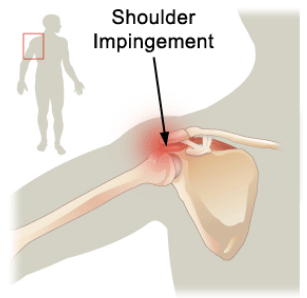
“Doctor, it really hurts when I do this.” I fully expected him to say, “Well, don’t do that anymore.” He actually didn’t say that. It’s an old joke that, when you think about it, is a bit condescending and wholly unsatisfying. And yet, it’s exactly what I’ve told countless clients who are struggling with dog behavior issues. My dog goes crazy when I take him on walks. (Don’t do that anymore). My dog bites me when I pet him (Don’t do that). He growls when I reach for his toy (Don’t). When my daughter’s friends run through the house… (Stop, please).

We trainers know the logic behind this. It’s called antecedent control. If we can shut down what’s triggering the dog, the behavior stops. We get a break. It really is part of the solution. I had stopped doing what really hurt the most long before I went to the doctor – reaching, reaching up and to the side, or bending low and reaching far like the time I tried to get my dog’s ball from under the sofa. That kind of pain makes it hard to get back up. Don’t do that anymore, right?

If you’ve never been, physical therapy is like going to a gym where everyone gets a personal trainer, an assistant personal trainer, and an intern. Insurance pays for it and the weights are pretty light. I liked it right away. It also helped me better understand dog training. Avoiding the shoulder pain was a good idea – just like sequestering a violent dog is a smart move. But it’s a bit unsatisfying. What’s the rest of the solution? The answer kind of surprised me – and I was surprised that it surprised me because of how closely in parallels dog training.
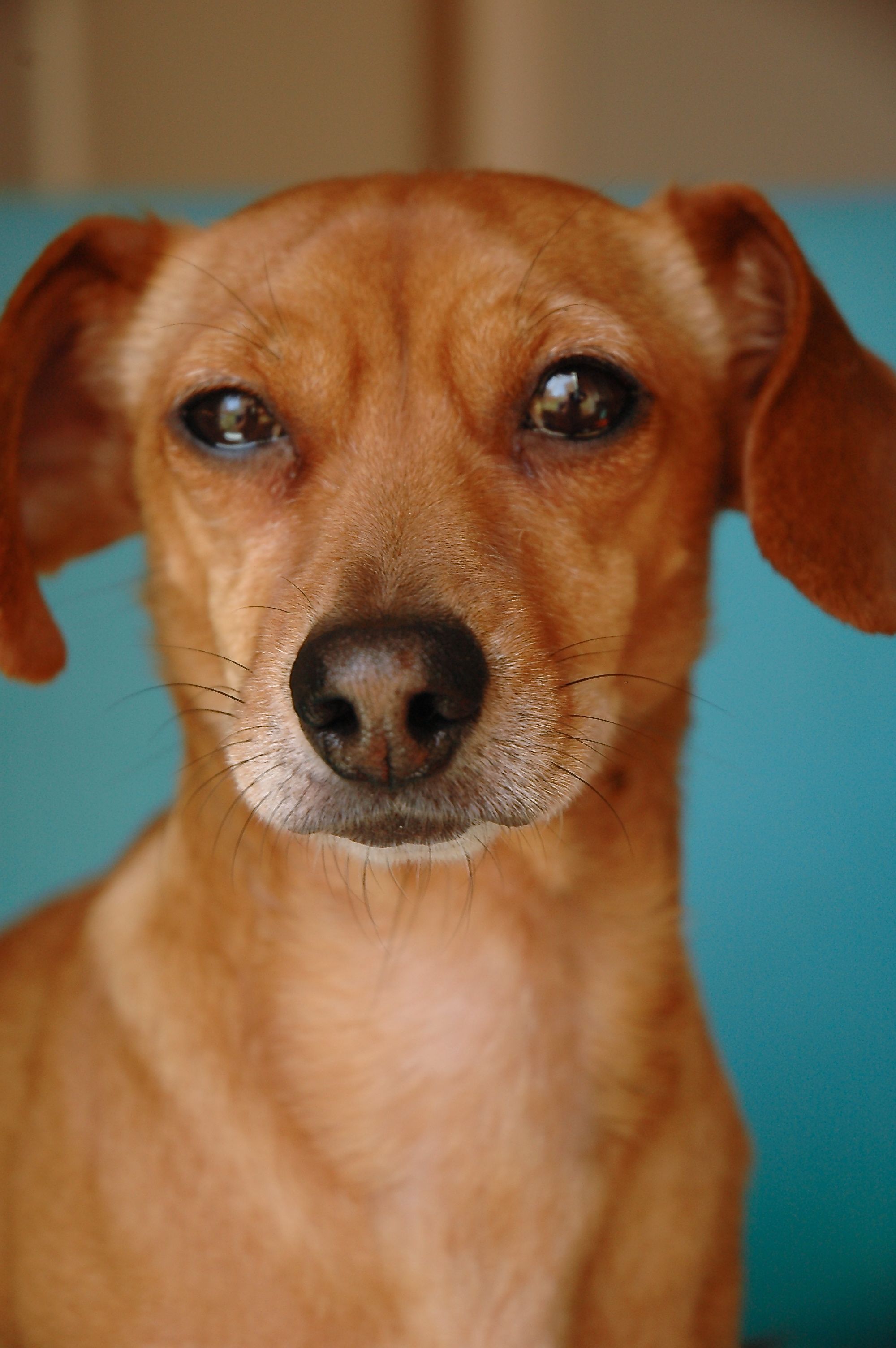
puppy-potty-trainingMany (okay most) of my clients think we are taking their hair-trigger cute-faced biter out into the world on our first visit to “see what happens.” As a trainer, I know that makes no sense. So, why did I think physical therapy for my shoulder was going to involve my shoulder directly – triggering the pain, stretching my arm behind my back, reaching for the peanut butter jar? What silly patient I was.

I’m not a doctor or a physical therapist, but here’s my understanding. Healing an injured joint is all about building the supporting muscles around the joint. Its also about relaxing the joint and creating room for easier motion. And all this involves teaching the body new behaviors, how to fire oft ignored muscles, how to sit and stand with better posture. For my shoulder it was all about working on my back. Go figure.

Sure, this was just a bit confusing at first, but so enlightening too. How odd it must seem to dog training clients when we begin teaching their angry dog obedience cues, impulse control exercises, and relaxation protocols. We know, but do we fully explain, that we’re teaching the dog behaviors that will support them when they feel the most stress or fear?We’re helping them self-regulate and relax so they can make better behavior choices when it matters most. Sometimes it doesn’t look at all like teaching the dog stop lunging, or biting, or growling. It’s about teaching new behavior and loosening the dog up around the problem area. Go figure.

Physical therapy, like dog training, can be challenging. There are regular visits and homework. Lots of homework. All these exercises for my back, teaching my scapula to move correctly, my chest to open up, my spine to curve correctly. In therapy and in dog training both, we break it down into individual tasks and build little by little. The dog attends to his owner more closely, targets the mat and her hand, follows better on leash, sits and lies down and stays. The routine gets boring at times – every day – more practice.

It’s hard sometimes to make the connection between the work and the goal. Maybe you notice, maybe you don’t, one day when your dog stays calm when another dog passes, walks away when you reach for his toy, snores peacefully when your kids’ friends run through the house. Maybe all you think about is that first warm cup when you reach for the coffee grinder, high up on the second shelf. You take your first sip before you realize – it didn’t hurt.
 

Food is not a Four Letter Word

Michael Baugh CPDT-KSA, CDBC

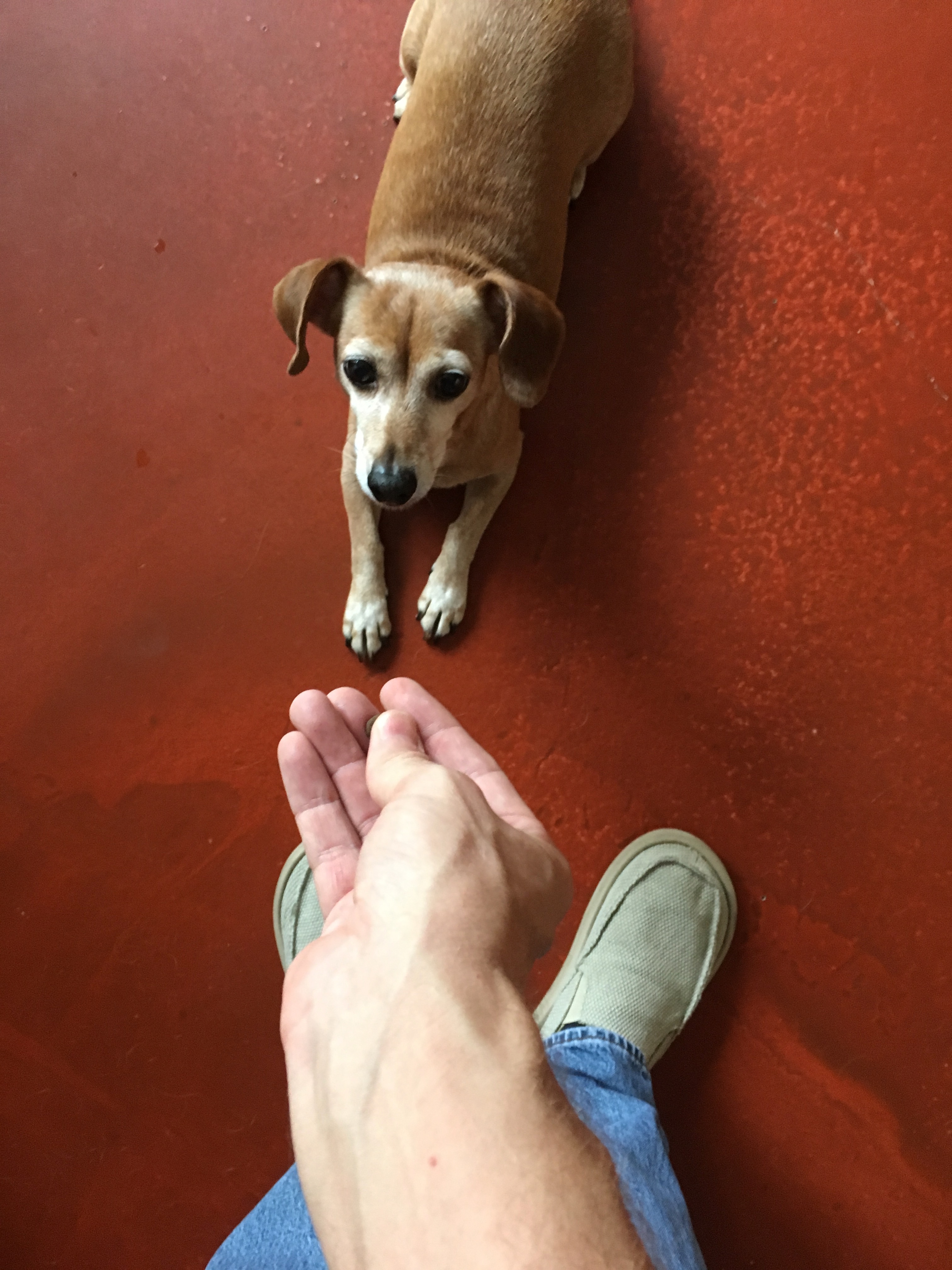
IMG_9994The question isn’t whether or not you can train your dog with food.  That’s pretty much a no-brainer.  Author and long-time animal trainer Dr. Grey Stafford put it best.  “If you’ve ever fed your dog, you’ve trained with food.”  Dogs have learned to do all sorts of things for their food bowl, including beg, spin in circles and jump on people.  What seems strange is that so many people would sooner give their dog a bowl of food for all that annoying behavior, than use small bits of food to teach desired behavior.  There seems to be a disconnect.  Feeding is good.  Food in training is bad.  Even some self-professed trainers advertise that they don’t use food in training.  Why?  Dr. Stafford inspired the title of this article when he made the claim that should be common sense to all of us.  Food is not a four-letter word.

Here’s how positive reinforcement training works.   If your dog spins in circles and barks, and the result is that you give him a heaping bowl of food, then he’s going to do more spinning and barking in the future.  It’s that simple.  Our dogs will keep doing the stuff we pay for.  In fact, it’s science (See “The Science of Dog Training”).  Dr. Susan Friedman PhD is a behavior analyst.   She cuts right to the meat of the matter.  “If behavior has no effect, what are we behaving for?”  So why not use the effect to our advantage?   Dog sits – food – more sitting.  Dog comes when called – food – more coming when called.  The list goes on.

Do you always have to have food with you?  No.  But (there’s always a “but”), it doesn’t hurt.  As your dog learns good manners, he may only get food every once in a while.  Many trainers refer to that as “phasing out the food.”  Use food to show your dog how to do new things (trainers call it luring), but don’t get stuck in a long-term pattern of bribing.  You should put the food out of sight as soon as possible.  Keep it handy but hidden.  Dr. Stafford speaks from experience, “I’ve trained hundreds of animals covering more species than I can recall.  The one lesson I’ve learned is the ultimate power of positive reinforcement, whether you train dogs or dolphins, is in its unpredictability.”  That means your dog will get paid for doing things you like, but not always how and when he expects it.  Any dog knows to come running when you’re wearing a treat bag, but try sneaking a few treats in your pocket, and then call your dog while you’re brushing your teeth or watering the lawn.  He’ll be mighty surprised when you hand him that food for a job well done.  Now, that’s unpredictability.

Is food the only way you can reinforce your dog’s behavior?  No.  But, some of the most potent reinforcers speak directly to the animal’s biological needs.  We call those primary reinforcers, and they include food, shelter, reproduction, and control (the ability to make choices).  In dog training food just happens to be the easiest primary reinforcer to deliver.  For professional trainers, food is often a first choice when teaching simple behaviors because you can get a lot more repetitions. Modern trainers pair the food with praise and smiles.  Those are called secondary reinforcers.  In time, praise, smiles, etc. will take on some of the built-in value of the food.  That’s a good thing.  You’ll want lots of possible reinforcers in your training tool kit.

What will your dog work for?  Some dogs love food.  But, other dogs will work for the chance to fetch a ball, play tug, or cuddle on the sofa.  Still other dogs learn to love petting and praise. Dr. Friedman notes, “It’s a teacher’s job to notice that individuality and use it well. The more reinforcers a learner has the more enriched its life can be.”  It’s our job to find what motivates our dog and to then use that to get the behaviors we want. Pay your dog for doing great things in lots of different ways, and see how that adds to the excitement from the dog we are looking for.  Your dog will work harder and learn faster because he’s always wondering, what am I going to get this time?

Is training all about the food?  No, and there’s no “but” about it.  Using food, pairing it with praise and fun, teaching your dog what pays and what doesn’t – that’s all about your discovering how to better communicate with your dog.  It’s about learning new things, looking for the next task, and loving every minute of it together.